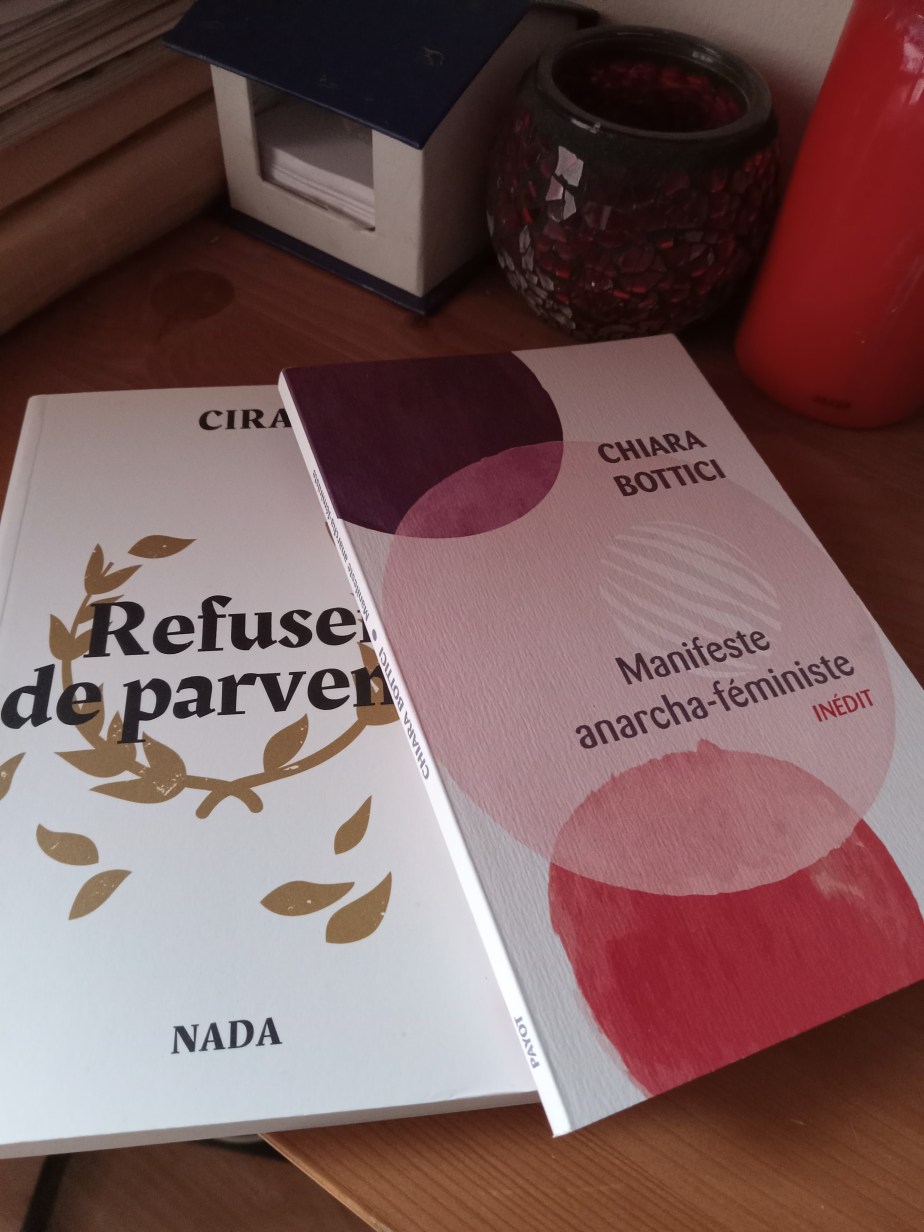
Books in 2025

If you read my blog, you’re probably familiar with my (attempt at a) tradition to post the most meaningful books I’ve read in the preceding year. I started this in 2021, when – not least connected to my work on epistemic positioning and the differential valuation of people who do not fit a particular ‘type’ of epistemic subject – I wrote about the year of reading only (or almost-only) books written by women and non-binary authors. I did the same in 2022. At the end of 2023, I was too burnt-out to write anything (my first – and so far only – Covid infection happened at that time, but it was only the crown of a pretty hellish year by most if not all standards); in 2024, I went back to the habit. I was in Belgrade, inspired by what was at the time a student occupation (of the building, and institution, that was my alma mater), and would grow into one of the biggest student-cum-civic movements in the region (I’ve written about it here and on multiple instances here, if you read Serbian/Croatian/Bosnian etc.). I wrote about books that gave me hope, a term I was never fond of and mostly did not use. And, of course, the events I witnessed in the subsequent year taught me to recognise and take it seriously.

I made up for one ‘missed’ year in February 2025, watching, from California the rapid (if not unforeseen) hostile takeover of the US, in particular the stepping up of immigration policing, and the (not-unrelated) crackdown on universities and, in particular, student protests. I wrote on books about resistance; not because I thought I had anything special to teach people on the ground, but because I was aware the Good Liberals of Social Media (likely most of my readership, though it’s possible I’m underestimating comrades) were comparatively under-prepared and inexperienced in dealing with *that* level of state collapse. There are both consequences and constraints to teaching people some of these skills at a practical level, so I thought the easiest and most useful thing to do, in the short term, is to share those written resources that were available internationally online.

Prior to that, however, I’ve made another decision. That decision had something to do with the process I’ve part-narrated here, but it also had something to do with the realisation that reading is a political act. Not in the self-aggrandizing, performative-intellectual mode that many still take for granted, but in the sense that the gift of attention is, truly, the most scarce resource. Thus refusing to dedicate it to either intellectual fads or resources considered de rigueur in a discipline (or, needless to say, the slop – AI-generated or not – on social media), and training it instead on something else is likely to produce unforeseeable consequences.

In other words, I only read books on anarchism.

Confession: I grew up anarchist, at least as far as early (very, shockingly early) drive towards autonomy and resistance to authority (which also led to multiple clashes with its institutions, something that should be a subject of a very different post) is concerned, but – until very recently – I rarely called myself one, not only because of believing (to paraphrase David Graeber) in the primacy of practice, but also because I have an innate dislike for fixed or stable “identities”, especially of the sort that trigger White Bros to either engage in (unsolicited, what else) “yes but” or approach with (pseudo-)questions like “but how would you solve the problem of [XYZ]?” (itself a reflection of the fact that they see every anarchist as Spokesperson for Anarchy, which betrays their assumption that every movement is in fact a PR operation). I read stuff on anarchism quite obsessively in my late teens and in my undergrad, haphazardly coming across random books, zines, and pamphlets then websites generated by Yugoslav/Serbian impressive plethora of publishers, organisations, distros, and samizdats, but it never made it into my ‘official’ academic portfolio (well, at least not as far as ‘formal’ references go). One part of it is the fact that anarchism is almost by definition opposed to academic conservatism, parochialism, and hierarchy; anarchists also tend to spur ‘scholarly’ publications and write instead for newspapers/magazines, zines, and blogs. Save for a few specialised corners of political thought, anarchist authors hardly ever make it into ‘the canon’. Of course, I quite inevitably read very much outside of the canon (and against it), but I was also socially aware enough to realise that trying to convince someone of the comparative value of Emma Goldman was not a particularly legit move in the academic establishment.

Also, I didn’t care. I never experienced the sort of academic (if only!) para-idolatric reverence some people feel for certain authors. Which is to say, I think there’s a lot of superb, really-relevant, useful writing that can be identified as anarchist (not all of which is signed by individual people, or at all, by the way), and I think there’s a lot of superb, really-relevant, useful writing that…isn’t. I read both; it has been my experience that, by and large, people are as inclined to ignore anarchist authors as non-anarchist authors, providing they are not white men. There are multiple ways to practice epistemic justice; in this process, the ‘how’ can be more important than the ‘who’.

Also, I forgot. By ‘forgot’ I mean that, having absorbed most of the writing available to me between 2000 and 2005, I moved on; carrying the little set of core values mostly unchallenged, not because I had the opportunity to act in accordance with my beliefs, but because I rarely had the opportunity to act in a way that made it clear how much they diverged from most of the orthodoxy. When I did, I systematically made choices that, sometimes incomprehensibly to myself, refused the hierarchy, authority, alliances, and rewards that, as someone pursuing a ‘career’ in the academia, I should have wanted. Of course, I also occasionally made – forced myself to make – other choices. This broke my heart; I swore never to make such choices again.

It’s easy to forget who you are. Academia makes it even easier, also, on occasions, providing you with extensive literature (and sometimes even academic posts, and promotions) that do that. This is what critics of ‘identity politics’ never get: it’s not (well, most of the time) individual people who play the politics. It’s institutions.

Deciding to willingly read only anarchist literature, then, was not only a way to reject the intellectual enclosure, sorting, and ordering that the academia never stops performing. It was also a way to train my own mind to be more open, courageous, and frank about what I think matters. To accept having to risk 1,000-word attempts to explain Marxist theory, or class politics, or the history of the Commune to me (it’s amazing how men never get tired of explaining things others already know about). Admittedly, it was also helped by the fact my current research engages explicitly with the anarchist intellectual tradition; that, too, was a choice.

More than anything, it was to dare to read not only outside of the academic but also of the anarchist canon; to refuse, consistently, to engage in the discussion about Did Kropotkin Really Mean That (you’d have to ask Kropotkin, and thanks in advance for informing me he is long passed, I totally did not know that); to focus on the practical, even if imperfect (nothing practical can ever be perfect) at the expense of the academically profound, even if writing is clumsy, to violate the academic canon of writing perfectly-formed, short sentences, with exactly the right balance of obtuseness and simplicity.

To disobey, terminally and forever, the enclosure that the academia seeks to perform on each and every one of us.

So, this year, I am daring you to do the same.

Refuse loyalty to the disciplinary, professional, intellectual, cognitive framework you have been raised in.

Refuse to perform ‘disloyalty’ by abundantly posting about your reading escapades, one Taschen catalog after another, one mainstream academic press publication after another, each with hefty royalties to the (star) author.

Refuse the fear of coming across as ‘simplistic’, or ‘uneducated’ (yes, academia makes you horribly under-educated, but not in the way you think), or ‘not sophisticated enough’; read for actual knowledge, read for pleasure, read for joy, read for hope, read for anger, read for vengeance, but most of all, stop reading only for yourself and whatever senescent gods of the intellectual realm you (still) serve and start reading for others, those who are alive, those who need it and cannot do it (either because they do not know the language or the jargon or are too misled by social media slop or are hungry or cannot read at all or are busy fighting fascists, feeding kids, getting arrested, burning out, trembling in face of the future, or have been systematically untaught to think and thus also to read) for themselves, or those who are yet to come, and who will be raised in a world of techbros’ dreams, where AI slop has successfully drowned out not only the capacity to think, but the memory of what that felt like.

Start now, and, as Crimethinc framed it, start everywhere.

(You will have probably surmised by now I am not going to give you specific books or reading suggestions. Feel free to start from your own gut – you can read short zines, pamphlets, how-to guides, or you can read classics like Silvia Federici’s Caliban and the Witch, Kropotkin’s Justice and Morality or The Conquest of Bread, or, of course, any mix thereof).

Here are some good places where you can access heaps of anarchist (and related) writing – and for free:

https://theanarchistlibrary.org/category/topic

https://libcom.org/

https://crimethinc.com/library

https://workingclasshistory.com/

https://www.marxists.org/ (yes, obviously, not all Marxists etc., but there are quite a few good resources here)

There are also several anarchist presses/distros (and it is always worth going to an anarchist bookfair if one is available in your part of the world, or going to the local infoshop/radical bookshop in your area).

Mercure Brigstow

To be fair, odds are I would have gone to any counter-demo in any city I happened to be in, even if it had been in front of a hotel I didn’t know, had never been to, and was unlikely to. This is just what I do. In fact, I initially thought this was a different Mercure in Bristol – one farther from the centre – which seemed more in line with the government policy towards asylum seekers, which is to get them out of sight and out of mind, so they can be usefully demonised. It was not until the day before the demo that I realised which Mercure it was, and that I had been there before.

Bristol held me. The first time I came to Bristol (save for a stopover in 2007, when I took a walk on the Quayside, saw a film at the Watershed, and was instantly hooked) was in 2014, for – initially – a seminar that was part of a job I hated and regretted taking. What sounded like a dream – tenure-track postdoc, secure, well-paid in a notoriously precarious academic environment, etc., with the possibility of staying on in what was billed as one of the bastions of social democracy – wasn’t; I was bullied and felt lonely and isolated in the sterile, conformist Danish social environment, ripped out from the precarious but dynamic, ever-changing, international, circle of friends and acquaintances at CEU. My primary relationship buckled under the pressure of another international move, combined with my disappointment in the job, and life, that everyone felt I should be settling down in. I felt very much the opposite, but struggled to see anything in the future that did not involve some version of the same. The only bright spots involved the possibility of extended research stays in Bristol and in Auckland, two of our project partners, so when a work event got scheduled in Bristol for February, I decided to bring a larger suitcase and not return until spring.

I still remember that first night. I don’t know why we were staying at the Mercury – I think the organisers at Bristol decided it was convenient for downtown and probably fitted the budget. I remember it being one of the nicer hotels I had stayed in – years of precarity combined with the desire to travel meant that I stayed in very cheap hostel and hotel accommodation well into my 30s; while Denmark was the first time my disposable income meant I did not have to worry about money, the country itself was prohibitively expensive, meaning that I was still having the more-or-less same lifestyle, just paying much more for it. It was not the hotel itself, however, but sitting outside it, on the Welsh back itself – I had snuck out for a cigarette (sorry!); the night was surprisingly mild, or at least that is how it appeared to me, my blood frozen by the unforgiving Danish northern winds – watching the glistening lights over the canal, that I felt happy for the first time in months.

Bristol melted me. It was not only my blood that had turned to ice over that first winter in Denmark; being in the southwest made me feel human again. It wasn’t only the casual smiles of staff in coffee shops*, or friends I (quickly, and thank you, you know who you are) made; it was also the fact that it was the only place (and to this day, even after more than ten years in the UK, even with the small exception of London) where I felt truly welcome. It was – still is – the only place where people would (occasionally, and casually) ask if I was from Bristol, rather than where I was from. In honour of that, one of my social media profiles still says I am from Bristol.

This, in sense, is true – I was born in Belgrade, but Bristol made me. The next time I came in autumn, I saw Nick Cave’s ’20,000 days on Earth’ – at the Watershed, where else** – went back to my room, and made a decision on how to live the next ten years. The rest, as they say, is history. While most of that history involved living elsewhere (Cambridge, London, and, for the past five years, the north-east), Bristol always felt like coming home.

It is not only that I came at the right time, at the cusp of the upswing of gentrification, but before the major part of the London fallout began. I lived everywhere – from a shared flat above a shop (yep) in Gloucester rd. (a lease I had taken over from a friend who has split up with her boyfriend) to a shared house in Horfield where I rarely saw anyone else to a horrible HMO in Clifton where they insisted the boiler room was an acceptable place to sleep; I stayed in friends’ flats, houses, gardens (usually lovelier than the boiler room). I went everywhere, walking, cycling, on the bus, and the railway. In between, I bid ny days in Copenhagen and elsewhere, waiting to return to Bristol.

It is also true that I was well-positioned as an outsider-in – I was doing research on how universities were engaging with local communities, so this gave me good access to both, at the time when impact had not yet begun to strangle the milder, less instrumentalised public engagement. This does not mean I did not witness, and was explicitly told about conflicts emanating from this; as elsewhere, universities (and particularly elite universities) are almost by definition conduits of gentrification. Even from this perspective, I (almost) always felt welcome; Bristol has no suspicion of ‘outsiders’ the way many other places in England do.

It is also not the proverbial ‘mildness’ of the southwest, memorialised in Banksy’s grafitti over Hamilton House. Yesterday, I watched that mildness scale up very quickly when crowds of angry, shouting men decked out in St. George’s flags showed up on either side of our lines, in front of the Mercure Brigstow. No pasaran.

As I said, I would’ve gone to any anti-fascist demo, anywhere. But the fact that someone is trying to prevent people who are, in a very different but very real way, seeking refuge at exactly the same spot where I found it*** – the Mercure Brigstow – meant there was no place I would have rather been yesterday.

*I write this with very much of an awareness of cultural expectations of emotional labour, especially in the so-called ‘hospitality industries’. While Denmark has a bit of a reputation for staff explicitly not performing it, which we can also attribute to decent labour conditions and thus absence of need to work for a tip, tipping (especially over-the-counter) was not a thing when I first got to Bristol either. People still chatted away in ways that, at least to my human-contact-starved Scandinavian eyes, seemed genuine.

** Of course, I also saw quite a few films at The Cube, including If a Tree Falls, another film that has been very influential on my orientation.

*** I’ve picked up on social media that one of Britain’s racism-loving publications has apparently used a similar angle to justify the far-right racist attacks on hotels hosting asylum seekers – apparently it’s “understandable” that people who have had their weddings there feel aggrieved to see the same places used to host migrants (as you can imagine, with the requisite set of adjectives/qualifiers added, incl. “off public purse” – despite the fact that it is explicitly the policy of the British government to ban asylum seekers from working – and “lounging”, despite extensive reports on how horrific conditions for asylum seekers in hotels actually are). I don’t think the kind of dour-faced conservatism that sees your ‘joyful’ occasion (= wedding) and someone else’s different kind of ‘joy’ (= being able to escape explicit oppression, persecution, starvation and likely death wherever it is you are escaping from) as mutually exclusive or even hierarchical (and if the latter, then in my view it certainly wouldn’t be the posh weddings that should be prioritised) is worth commenting on, but I do think there is another kind of resentment fuelling the far-right that does merit more attention. Given some things we know about the social composition of the British far-right (leaving aside for the time being the social composition of those who fund and direct it), I think it is more likely that their resentment stems from their own (perceived) inability to afford the exact posh weddings in the exact same hotels that the said article (which I won’t link to) is nostalgically referring to. Which only confirms what we already know, which is that one of the aims of far-right mobilisation in the UK is to divert attention of the working/exploited precarious class away from the (very needed) economic redistribution and onto attacking migrants and minorities.

Revolutionary time

I don’t recall when was the last time I slept throughout the night. The barricades are almost literally under my window; the fact I am between two occupied faculties means I spend most nights at one of the blockades, then being woken up intermittently by garbage trucks (which are sent to clear out the road blocks) and the police (which comes to break the blockades, beat and arrest people). There is also the general noise of a protest movement – whistles, cheers, slogans. I generally let the bin people do their work (in Serbia, these kinds of workers often don’t have a choice), not the police. I got used to the sound of protest, though not sufficiently to not wake up.

A month or even a few weeks ago, this would have been a problem.

For a long time, I’ve been reluctant to write about Serbia, or even answer questions about what is going on. For ethical reasons, I believe in platforming people who are on the ground, and while I am from Serbia – and from Belgrade – I have not lived there for a long time. I resisted being pinned down (domained, as I’ve called it a lifetime ago when I still cared about things such as knowledge production) as being ‘from Serbia’ or a ‘Balkans expert’ or even a ‘post-socialism scholar’ (despite the fact I’ve written a book on Yugoslavia and its successors). Whenever someone asked me for an interpretation or an opinion, I kindly pointed to people who are actually in the region and who I thought knew what they were talking about.

Almost equally importantly, I believe the usefulness of ‘interpretation’ is very limited. The intellectual tendency to focus on knowledge production – on writing, publishing, speaking – in crisis can contribute to the perpetuation of status quo; this isn’t to endorse a simplistic ‘words vs. deeds’ dichotomy nor to elevate action beyond the status of questioning (after all, we must think about what we are doing), but to note that, for most of the past decade, most contexts I have encountered have had an overabundance of critique, and a corresponding dearth of action. I have, in fact, written about that too – a whole PhD and some – but in the past year(s), I’ve become very reluctant to offer any interpretations, and have instead focused on calling upon people to act.

Now I must, though, not because I have an investment into the position of an ‘intellectual’ (you can read about my departure from that position here and here), but because the situation calls for it. Not because it needs interpretation, but because it exceeds it.

So, confession number one: this situation has exceeded my interpretative capacity.

I’m conversant in roughly five disciplines, so this isn’t for a lack of options. Sure, I can give you political philosophy names for what’s going on, and sure, I can also give you a Marxist perspective, or maybe a slightly longer-durée historical/political economy explanation. I can waffle on about semi-periphery, extractivism, necropolitics like a champion (I have). Like a retired lute player, my mind occasionally touches the floating signifiers of the concepts others have used: Badiou’s ‘event’…Žižek’s working through of Lacan’s subjective destitution with a ‘radical act’…Butler’s performative theory of assembly…Honig’s morphing of inoperativity (Agamben) and power of assembly (Butler)…and Clover, Osterweil, everyone on riot.

Unimportant.

None of the concepts match stuff I have seen.

Here, another confession.

Yes, as far as identities are concerned, I am an anarchist, and yes, I am an anthropologist, and yes, I am also a Buddhist, but I have always been ambivalent about the idea that people are inclined to do good in situations of crisis. I believe people are inherently capable of acting in any number of ways – selfish, altruistic, appropriative, non-proprietary, exploitative, generous – and that it is a complex set of circumstances and evaluations decides how they will act in specific situations. Hell, my current research – Uncategorical imperatives – was motivated by the belief we’d better find out how we tend to act (or: morally reason about action) in crises before climate change-driven exploitation and wars collapse into global disorder.

Whoops.

But (trigger warning: a Bladerunner ‘time to die’ monologue)

What I have seen on the barricades (blockades) in Belgrade surpasses what I know about social movements, informal organisation, or human behaviour. Don’t get me wrong – I was in protests since my mid-teens, including in 1996/7, 2000, and many, many other. I have been in protests in Budapest, the UK, the US. I also visited the occupied faculties in Belgrade this winter. I’ve been in protests in early June. I’ve watched, half-crazed with worry, the footage of the 15th March and 28th June protests.

This is different.

I have seen examples of mutual aid, solidarity, restraint, and self-organisation that go beyond what textbooks on mutual aid, self-organising, and community building tell you. I have seen examples of courage, protection of the weak, and having each other’s back that I have only seen intermittently before, except that they are now sustained and unquestioned. I have seen or heard, narrated, first-hand, forms of creativity, ingenuity, and resistance that I have read about, but never thought possible. I have seen anarchist theory, in practice.

Confession number three. I never thought this could happen.

Yes, I read the reports, and for a long time, all of that was encouraging, but not impossible. Everything fit the predictable range of human behaviour, one that follows identifying a common enemy, and organising around a similar cause. There was a foreseeable scope of outcomes.

This is different.

Please don’t try to explain, as I still can get angry. It’s different.

One of the things I remember reading (can’t recall the reference – might’ve been Rosa Luxemburg?, and it anyway no longer matters) is that the revolution does not involve only changing the system; it involves changing you. You will, literally, not be the same person after the revolution. We are no longer the same selves, and this is coming from someone who already believes identities are an illusion, and not a very interesting one.

But it is still tangibly different.

I know people tend to lose themselves in historical moments. (Here is Badiou’s event again). I’ve read endless accounts of transformative experiences, from 1917 and 1968 (both in Yugoslav republics – also, my mum participated in it – and beyond), to Occupy, to first environmental protests, Seattle, Gezi Park, Tahrir, you name it. I understand that. But this isn’t a ‘change’, be it ‘regime’ or ‘social’, or even ‘system’. I’ve witnessed happenings – some personal, like love, some interpersonal, like death, some communal, like concerts, some spiritual – that have come close to transcendence. This is not it.

It is also not the (a)voidance of doubt, of incertitude, or anything that seems like discomfort. It is the realisation that this is what we do now. This is how we live. There is no ‘end’ or ‘goal’ or even ‘victory’. There is no teleology.

This is revolutionary time.  

Confession number four. I am afraid.

Some days ago – I do not recall when, where, with whom – I was in a protest, and, as is my habit, tried to get the person with me to shift to the fringes. You see, I am uncomfortable in crowds, and my strategy – for close to 30 years now – is to avoid being kettled, so I can quickly run if the cops descend. It has kept me mostly safe, with one small exception.

Now I stand. Not because “the movement” or “the revolution” is transcendent, worth sacrificing for, or because I’ve lost myself in the adrenaline of the crowd. Because this is a choice. A choice that came earlier, and slightly differently, than I expected (I honestly thought I’d die fighting masked government agents in the UK or the US, but here we are). I stand because this is what we do now, and in perpetuity.

P.S. Thought it important to add a few remarks, lest people start thinking I’ve completely lost critical capacity: (no, I’m just very underslept :)) – critical in the sense of critical friend, not as someone who is looking to form an intellectual position. These are meant to highlight some of the areas for further work, especially if/when the blockades morph into more long-term forms of organising:

  • the fact homophobic language (crowds occasionally chant or spray “gay” as derogatory term for Vučić) regularly makes an appearance should be addressed immediately. homophobia is not funny, not even as a throwback to that mid-90s high-school playground vibe. the country should really move on from there, not only because nobody wants to go back to mid-90s, but also because homophobic violence is still alive in Serbia.
  • the resurgence of ethnic nationalism, not only in terms of rhetoric (which, even if it is your thing – it certainly isn’t mine – is entirely and utterly politically useless, given that the only national(ist) project Serbia could conceivably pursue entails trying to reclaim Kosovo, which no-one in their right mind would want to do), but also in terms of (again) shouts and slurs; e.g. shouting the derogatory term for Kosovar Albanians at police (reminder, the predecessors of those forces were actually engaged in committing crimes against Kosovar Albanians, so the slur is not only racist/chauvinist, it is self-defeating). Same goes for shouting at police to “go to Kosovo” – it should really go without saying that organising against police repression in your own country makes little sense if you are at the same time encouraging the police to go and repress the people in another.
  • glorifying masculinism and masculinity – while elements of this tend to be prominent in all protest movements that feature substantial physical labour/force (e.g., flipping over heavy garbage bins, etc.), it tends to erase (a) the fact that most of this work is *also* done collaboratively (in fact, the most recent one I’ve witnessed was performed by a very gender-mixed team) and (b) the relevance of organisational, logistical, and communication labour, most of which seems to be performed by women and non-binary folk. this has been accompanied by an unprecedented platforming of men (as ‘heroes’, speakers, leaders, experts, commentators, whatnot), often with names, while women mostly appear as generic category (“young women [devojke]”, “student [studentkinja]”). While there are good reasons to stick to anonymity in times like these, this should be equal across the board. There is a good lesson to learn from the Zapatistas here, whose ‘Revolutionary law of women’ was the first and integral part of the Chiapas rebellion, not an afterthought.

Three ghosts of British higher education

[These are the more-or-less unedited notes for my speech at the event Multiple Crises of Higher Education, held on 20 May 2025 at Queen Mary's Mile End Institute, and organised by the fantastic Accounting and Accountability Research Group. Queen Mary's branch of UCU have also been at the forefront of fighting and writing about redundancies in the sector, and maintain an excellent and well-organised webpage, so give them a follow alongside AARG (the best acronym in the sector?)]

To start, as philosophers do, from examining a concept, a crisis means a point of shattering; sense of rupture; breaking point, crack in the fabric of reality. To say something has reached a crisis is to recognise that from this point there is a division into multiple paths. From a personal perspective, to reach a crisis means we can no longer go on as before, or as usual; a crisis usually invokes a reconsideration of what the project (whatever project we are committed to – a movement; an ideology; a job; a relationship; an idea) is, and whether it is still worth doing or living.

So when we start from the diagnosis that higher education is in crisis, we are in fact acknowledging that multiple facets of what we thought higher education is are no longer viable. Some of these (also mentioned in the description for this event) include the sector’s funding model; its approach to academic labour, including benefitting from precarity (insecure, temporary contracts) and competition (for research funding, for prestige); and its relationship to other important sectors of society (government, the military, industry, and so on). But where do we go from here?

To foreground the question of where we go from here is also to acknowledge – or argue – that turning back is no longer possible. This is the starting point for my remarks today. I draw inspiration from Adam Phillips’ On Giving Up (am currently reading the book, but the link is to the – open access – essay in the LRB), which opens with Kafka’s Zürau Aphorisms: “from a certain point there is not more turning back. That is the point that must be reached”. To say we are in crisis, among other things, is to say that we have reached that point. From here, Phillips asks: what are we willing to give up in order to go on living?  

Philips’ question reframes giving up as a fundamental element of worth. As worth is the key of valuation and as such of any kind of counting, including acc-counting (sorry), I believe it is tantamount to understanding how we talk about value. In this sense, I intend to perform an analysis that sketches in more explicit terms this intersection between moral and economic; between what we give (and expect to receive in return), and what we give up on.

Giving up/going on

I want to argue that any analysis of a ‘crisis’ that harbours the illusion that turning back is a possibility is one that is fundamentally committed to maintenance of the status quo, and thus counterperformatively denies the very diagnosis is purports to establish. Indeed, it is quite possible to argue – in analogy with how some Marxist critics have described the 2008 economic crisis – that there is, in fact, no crisis at all, and that the system is working exactly as intended. The major thing I will be arguing we need to give up on, in this consideration, then, is our commitment to the system as it is, given that as it is it is a system working as intended.

So from there, we need to reorient ourselves, perhaps towards a different system, perhaps towards one working towards different ends. To do this, however, we need to rid ourselves of three ghosts. Three ghosts, a bit like in Dickens’ The Christmas Carol.

The first ghost is the ghost of the Empire. Now, some of you may be surprised by the appearance of this ghost. After all, haven’t we comprehensively purged this ghost by decolonising our curricula, by extensively renaming our halls and libraries, even – gasp! – in some cases, by enquiring into our links with slavery?

But this ghost rests barely disguised in the ideal of the superiority of British higher education, the idea of higher education as an ‘export’, and the almost unquestioned assumption that we should reap profit from international students. For what is the source of appeal of British higher education for (most) foreign students today if not the accessibility and usefulness of an education in English (the language of global trade, the fact we owe to the British Empire) combined with the opportunity to take endless photos in front of different vestiges, artefacts and similes of that very empire, from the Big Ben to Harry Potter-esque halls in Oxford, Cambridge and Durham? What is the ambition to be on top of league tables if not a transmogrification of the desire to sustain a hierarchy that was built on a monopoly on trade routes and cotton mills, and now continues through degree mills? Finally, what is the belief in the ‘superiority’ of British higher education but an inflated ego projection of our own (yes, I am British now) colonial past, which in turn enables if not validates the racialised and classed hierarchy of the UK immigration system, the system that requires people to prove their ‘worth’ in order to be exploited as much as (or more than) British nationals?

The second ghost is the ghost of welfare state. Now, quite contrary to the previous, the ghost of the Empire, this one is the kind of ghost we repeatedly and obsessively summon. We do this in ritual invocations of the famed social contract that created the NHS, or in the postwar (meaning WWII) expansion of higher education, enabled by the Education Act in 1944 but usually attributed to the Robbins report (1963), which opened higher education to “all who qualify, by ability or attainment”.  

The most important contribution of the report, perhaps less visible because it was bordering on the obvious, was to, for the first time, conceptualise higher education as a system and thus a distinct domain of public policy. In 1964, the University Grants Committee officially became part of the newly created Department of Education and Science (DES). Instead of a set of disparate universities and colleges, with their histories, traditions (or lack thereof), and institutional trajectories, higher learning became a matter for the nation-state – and, consequently, its development deemed relevant for the well-being of its citizens (citizen-subjects) on the whole, not just for the (still small) proportion of those who attended the (equally relatively small) number of institutions. This is how the massification of higher education became the main ‘lever’ for state intervention into university governance. The essence of the ‘social compact’ between the university and the state, thus, was always a tradeoff between expansion and funding.

It is important to note that this social compact intentionally excluded international students, who were exempt from no tuition fees since 1962. It is also important to understand/acknowledge how it occurred in the first instance. The expansion of higher education was not some benevolent act of enlightenment (well, neither was the Enlightenment a benevolent act of enlightenment, after all 😊); it was a strategic investment into upskilling the workforce so as to enable UK – no longer an empire, at least by its own lights, though still very much keeping overseas territories – to compete in industrial production, including that of weapons and surveillance technologies. This is explicitly acknowledged in EP Thompson’s edited Warwick University Ltd., which documents the analyses and reactions to the revelations made during the student occupation of the Registry of the University of Warwick in 1970. The files students found revealed widespread labour surveillance and military contracting, including to Bristol Sideley Engines, the predecessor to British Aerospace Limited, which which provides jet engines to Saudi Arabia and Israel (if you’d like to see the continuing links between universities in the UK and arms manufacture/trade, I strongly recommend this). This critique, however – just like Thompson himself – stopped short of reimagining higher education that would not be beholden to national (and, increasingly, offshored) industry, even if that means arms industry.

This also tells us something about the vestigial dream of a Labour government restoring this ghost of a welfare state to its former glory. Recent policies suggest Labour has no intention of dusting off this model of the social compact. More importantly, however, it tells us something about the ethical tradeoff involved in the dream of higher education as part of a welfare state – whose welfare?

The third ghost, and this is going to be most difficult for some of you to hear, is the ghost of social mobility.

From this post.

This brings me to the diverging (or converging, if you’re a fan of strict visual metaphors) rates of graduate debt and graduate premium.

There are different policy solutions proposed to address this, and today we have heard some of them. What we fail to comprehend, however, is that the graduate premium itself is based on the idea that there should be an exploited and underpaid class of (under)labourers. It makes sense to remember that the concept of ‘social mobility’ assumes that there is a class to escape from (move out from), usually the working class, and a class to aspire to, usually the middle class.

The fact that the ‘graduate premium’ is stagnating or decreasing apart from in a few professions/sectors (and we know what those sectors are – finance, fossil fuels, big tech) tells us little about the intrinsic ‘value’ of higher education (as if there were a thing such as intrinsic value) and more about wage suppression across sectors.

After all, in an equal society, where we would all be paid the same, what would be the reason to have a graduate premium?

So that people can pay off debt; and this brings me to ‘the system is not in crisis, it is working as intended’.

Why should we expect a graduate premium?

Not long ago, I encountered the same question in a session on cooperatives.

It was run in the local community/anarchist centre, and I came by to hear what people thought setting up a cooperative would really be like. When it came to the distribution of income, I mentioned that I thought it fair that people be paid the same kind of money for the same kind of work, and that that was the principle I tried to institute in one of the collectives I had been part of (The Philosopher).

But what would people with PhDs do? Asked one participant.

Be paid as everyone else, I said. Independently of qualification? They asked. Of course, I said. (They did not know I had a PhD – two, in fact).

But why would people with PhDs agree to that, they protested. After all, they paid so much for their education, they surely have to earn more to pay that off!

And that, my friends, is why we cannot have nice things.

Because as long as we cannot accept – or even conceive – that knowledge (by which we mean tokens or credentials of knowledge) should not bestow material privilege, as long as we accept inequalities in employment, as long as we cannot even imagine that a ‘professor’ could be earning the same as a ‘lecturer’ and as a ‘teaching assistant’; let alone as a cleaner or a nurse, or, if we want to bring this closer to university contexts, as an IT technician – we are both naturalising and reproducing this hierarchy. This hierarchy tells us that of course higher education should confer a privilege, and of course there should be an (over)exploited and (under)paid class, and of course British higher education bestows that privilege (particularly luxuriously), so of course we have the right to ask people to pay for it, and foreigners to pay even more. Unless we are willing to give that up, we are not only tacitly but, what is I hope by now obvious, explicitly accepting that higher education is an instrument that serves to reproduce and maintain the status quo. If anything, it is intended to maintain graduates tied to low-paid, precarious, and exploitative jobs – think Starbucks – that they cannot get out of, even if they would want to, because they have too much debt. And there is one thing people like that are unlikely to do: create any kind of meaningful, longer-lasting, opposition.

So what we need to give up, in order to go on, is the fantasy of exceptionalism – institutional, sectoral, or personal. That universities (as institutions), higher education (as a sector), or the fact we are in them, makes us special. And even if we are committed to status quo – and it remains my belief that many academics who would call themselves ‘radical’ or ‘progressive’ are, in fact, deeply committed to it, not least because they cannot imagine alternatives – it is clearly breaking down. So we cannot go back. The question is, where shall we go forward?

P.S. Some people asked me about other stuff I had written on the topic. Most academic publications are listed (in chronological order) under Articles and books; I also blog and write invited op-eds. Some of the stuff directly relevant for this one are:

On the relationship between academic freedom, autonomy, and the state:

On political economy of higher education, including the relationship between extractivism and knowledge production:

On the relationship between social change, social inequalities, political subjectivities, and education policy:

and, of course, my book:

Bacevic, J. 2014. From Class to Identity: Politics of Education Reforms in Former Yugoslavia. Budapest and New York, NY: Central European University Press.

Reading (on) resistance

I’ve been in the US for about a week. The feeling of utter shock, panic, and disarray among people – qualitatively different from what could be discernible back when I was across the pond, qualitatively different from the previous Trump regime, qualitatively different from many previous instances of ‘unprecedentedness’ I had written on (the Covid-19 pandemic, the Brexit referendum, Trump’s 2016 election victory, the breakup of former Yugoslavia) – is tangible. Good centrist liberals and their projections are falling like planes out of the sky, the latter, by the way, not a metaphor at all.

It is easy to be both dismayed and cynical, but both are, ultimately, defense mechanisms. To give into collective panic/despair is (I guess) to at least temporarily redistribute anxiety by letting it dissolve into a collective feeling. To knowingly smirk with a “we have, in fact, told you so” may be easy for someone like me, who works on the politics of non-prediction, and is relatively protected from dismissal, deportation, or incarceration, but it is a way of insulating yourself from the collapse that is very real, and very present, for a lot of people. Given that I am, for better or worse, in a plethora of social networks that are dominated by academics, and give that academics are more

likely to be like this

than like this

let alone like this

the least I can do, then, is to offer some resources for resistance, from the perspective I have (east-central European/transnational, UK-domiciled migrant; woman*; educated, middle-class; some experience of movement, organising, etc.) and with the resources (and constraints) I currently have. None of this is meant to be exhaustive (maybe just exhausted :)) and hopefully only adds to the bountiful and excellent resources, networks and initiatives comrades in the US have been building for years.

The Emperor is truly naked – but still an Emperor

I think what most people are experiencing now is best described as cognitive dissonance about the state. On the one hand, they are becoming rapidly aware that what they believed are the stalwarts of liberal democracy (the rule of law, checks & balances, accountability and the like) are barely scarecrows that can be blown away overnight, and the crows are no longer scared. On the other hand, they are beginning to realise — if they had not before — what truly unchecked power looks like. (Every leader, potentially, is a dictator; the fact the US has a presidential system, with high weighting on executive power, just makes it more likely there will eventually be one not bound by convention to hide it). This means that, for a lot of people, the state is simultaneously all of a sudden very absent (FAA being just the most obvious, and immediately high-risk, case) *and* very present (both in terms of intrusion into domains most Americans are taught to associate with ‘privacy’ – finances – and in terms of threats of further deportation, incarceration, and retaliatory dismissal).

For those lucky enough to be able to think about (rather than just react to) these developments, this poses a problem because it places them in the uncomfortable zone most people have been politely educated out of: thinking about what to do when the state fails in a way that does not entail asking for more state. Surprise! There is a whole group of political theories that engages with exactly this problem. It starts with an A, ends with an M, and is not animism. Even better, many of the classical (and more recent) works in this line of thinking just end up being magically available, online, for free. Two particularly good websites for this are here and here. I know, wild. Worth thinking about, if nothing else, because it also turns out many of these will probably give you good ideas for how to face the next couple of years.

In addition to or beyond this, or if you just want to get the hang of self-organising without having to confront your own ideological limits (but if you do: try here, here, or here), these are some of the handy reading tools I’ve selected a few from the list of my favourite books in 2024, and added a few I believe to be most useful for the present situation.

  1. For brief inspiration: To change everything (CrimethInc)
  2. To see the work done by collectives across the world, including during the previous Trump administration: Constellations of care: anarchafeminism in practice (ed. by Cindy Barukh Milstein)
  3. To remember that anti-neoliberalism does not equal nationalist protectionism: Fields, factories and workshops (Petr Kropotkin)
  4. To learn from organisers who have been doing it for a long time: Shut it down: stories from a fierce, loving resistance (Lisa Fithian)
  5. To learn how to organise and not burn out (and also not be terrible to other people if you do!): Let this radicalize you: organizing and the revolution of reciprocal care (Kelly Hayes & Mariame Kaba)
  6. To not forget that there is no way to address a political crisis without addressing the climate crisis (and, of course, capitalism as the root cause) – but that there are so many ways (already tried and tested) to do it: The solutions are already here: strategies for ecological revolution from below (Peter Gelderloos)
  7. To recall that some people have, in fact, foreseen this: The Parable of the Sower & The Parable of the Talents (Octavia Butler)
  8. To acknowledge that when you say “someone should do something” that someone is, in fact, you: Mass Action (Rosa Luxemburg)
  9. To remember that there are many other places where this, and worse, had been true for a long time: We are not pawns, we are people who rose against the regime (Jwana Aziz)
  10. Again, CrimethInc: tools and tactics

This should be more than enough to start from. Get reading.

*I realized, upon reflection, that this term is a bit inaccurate – I am comfortable with ‘woman’ or ‘she’ in languages where gender is primarily grammatical (so where chairs, stones, and concepts have a ‘gender’), both for convenience and because it is more difficult (but not impossible) to associate grammatical gender with hierarchical difference; but I have never felt any degree of affinity with the cluster of ideas around supposed feminine ‘essence’, even if they do not veer into biological determinism, reductionism, or transphobia. It is thus that in these languages – and contexts, UK being one of them – that I tend to use ‘they’ or ‘she/they’.

On books and hope (2024)

This is the continuation of the habit I have kept for a few years, which is to write a post on books I have read that year. That said, “habit” is hardly a deserving name for something I did two years I a row – in 2021 and 2022 – and then dropped in 2023: the year had been too filled, both with ups and downs, and the context in which I read some of those books too convoluted; it is also possible I read more than I usually would (having been on research leave in spring) – or less. I wouldn’t know, as I gave up on keeping a list; I gave up on many other things, including possibly the last vestiges of ego-investment in the academia, which also meant I gave up on reading for competitive, pedagogical, or perfunctory reasons. In this context, coming up with a list of all the books I have read would have seemed a bit counterperformative; not least, the time I would have normally spent writing up this post – the quiet days after the end of term, as Xmas and New Year drag themselves over the hill – was spent flat out from Covid (which I finally caught, one and so far only time) and the ongoing pressure at work.

This year, I am coming back to this, but in order to share the books that brought me hope. This may seem like an odd choice for someone whose approach to knowledge always emphasised the ethical and political responsibility of recognising tendencies in the present that may lead to harmful and disastrous futures – even if that entailed coming to terms that, in not-insignificant ways, our present (in)action may be rendering certain kinds of futures impossible. This, for most of my life – starting with the rather famous moment when, aged eight, I argued to my father that Yugoslavia will fall apart – meant having the courage to be a ‘killjoy’, not only (or primarily) in terms of disrupting the cozy consensus that scaffolds some of the most odious things about contemporary social life – consumerism, patriarchy, xenophobia and racism – but also by pointing out, ceaselessly, that bleating starry-eyed about the revolution to come was, in very real ways, preventing us from bringing it about.

To toss the concept of ‘hope’ about might, from this perspective, seem at best a concession to sentimentality, in the same way in which I dutifully bellow ‘Merry Xmas’ back at people; at worst, like capitulation to the abscondence from the daily work of not reproducing the same systems that we (so eloquently) critique, which intellectuals of my sort are prone to, especially when we reach a certain career (st)age. I, at least, have always swatted away questions of hope or ‘exit’ (as one of my PhD examiners exasperatedly sighed towards the end of my viva: “Then there is no Aufhebung?”), in the same way in which I used to swat away questions of the sort of ‘What is to be done?’ before I decided to start doing less of knowledge production and more of…other stuff.

Why hope, then? Put simply, one of the rare justifications I find nowadays for continuing to do “academia” is that (nominally, at least) it entails two things: time to read (one might say, an obligation) and a platform to tell others so (as well as what not to read). And everyone needs a bit of hope. This is particularly important as I see growing numbers of (even educated) people fall for trash arguments along the lines of Stephen Pinker’s ‘Better Angels’ or other kinds of Pollyanna-ish optimism that usually serves to bolster capitalist, extractivist, or neocolonial approaches to ‘business as usual’. Thus, to be able to see ‘hope’ without, at the same time, ‘unseeing’ all things that render it impossible (the war in Gaza; continuous extraction; runaway climate crisis) becomes a difficult exercise in discernment and balancing – something that, in fact, academics of my sort are uniquely trained to do.

That said, not all of the books included in this list count as ‘academic’ – and most would not But they are what sustained me over the past year. I hope they can be of service to you.

Revenant ecologies: defying the violence of extinction and conservation (Audra Mitchell)

This is a book that challenges powerfully the thinking about extinction and conservation that dominates Anglo-academia. Particular points for taking a swipe at the ‘extinction industry’ of academic writing, and the books (many of which I admit I had enjoyed!) that write about extinction from a seemingly universalist perspective. On the other hand, Revenant Ecologies seems at times to take almost excessive care to avoid this. Regardless, it is a careful, engaging, and mobilising analysis that aims to avoid the po

As we have always done: indigenous freedom through radical resistance (Leanne Betasamosake Simpson)

I’ve admired Betasamosake Simpson’s writing for a long time (and also music! How cool it is to be a social theorist who also writes and performs music). This book is a reminder that undercurrents of resistance run deep, but also that freedom is a praxis – a constant one, at that.

Our history is the future: Standing Rock vs. the Dakota Access Pipeline, and the long tradition of Indigenous resistance (Nick Estes)

QED. Well, maybe there is a bit of a theme running through this year’s reading. But in a year that felt so long, and hopeless, and dark, I needed (printed) reminders that people have lived through (and survived) worse ordeals, and that they not only did not accept but actively challenged and fought against the colonial order and its successors, including extractivism.

Ecology of wisdom (Arne Naess)

Naess is one of those people who are larger than history gives them credit for – he is usually styled as the ‘founder of the deep ecology movement’, but Naess was a philosopher (prefiguring a lot of analytical thought), an ecologist, a spiritual thinker (a Buddhist and firmly committed to nonviolent action), and a mountaineer. ‘Ecology of wisdom’ is a compendium of his writings; thanks, in part, to masterful translation, the prose just flies off the page making it more like poetry (I’ll admit that the combination of analytic philosophy, Buddhism, and ecology is particularly likely to chime with how I feel and think about the world). Nonetheless, I find it hard to think anyone would not be charmed – at least anyone who still has a heart, and soul, in some part of the magical world we inhabit.

And if you need a reminder how to (re)discover it, these two are highly recommended: Reclaiming the wild soul (Mary Reynolds Thompson) and  Enchanted life: reclaiming the magic and the wisdom of the natural world  (Sharon Blackie). I *really* like Sharon Blackie’s writing – it manages to be equal parts environmentalist, witchy, psychoanalytic and folksy without becoming too bound by conventions of any.

Foxfire, wolfskin: and other stories of shapeshifting women (Sharon Blackie) is a wonderful retelling of some of the classical European folk tales, with a gender twist that does not come across as pedagogical. I absolutely adored it – and even got it for a few friends.

A natural history of the future (Rob Dunn)

This is a great (admittedly, popular science) book on the impacts of the ongoing climate change and other human-induced changes on the biosphere. It brings in new arguments and perspectives, even if you’re a seasoned reader of the genre, and I’d say it’s informed by deep ecology whilst retaining a pleasantly matter-of-factly tone.

Claros del Bosque (Maria Zambrano)

I used the two unforeseen trips to Serbia in springtime to delve into the rich body of non-English philosophical and theoretical works in translation, something I dearly miss in bewilderingly anglo-centric UK (even major works in French or German are increasingly translated with a delay, if at all). I chanced upon the Serbian translation of Zambrano’s Claros del Bosque (forest clearings? ) in one of my favourite (independent) bookshops, but given that 2024 was also the year in which I decided to refresh my Spanish, I also got the original (the combination proving the right level for my Spanish reading skill). Zambrano (a metaphysician, essayist, and Spanish republican) was yet another ‘forgotten’ philosopher whose work I enjoyed discovering in the past two years, alongside Anne Dufourmantelle and Mari Ruti; her writing also reminded me of Clarice Lispector, with the combination of the poetic and the philosophical.

Drive your plow over the bones of the dead (Olga Tokarczuk)

I returned to reading Drive your plow…late this year, after a chance encounter on the plane this spring reminded me it was one of the (many) books I had been meaning to come back to. Let’s just say I do not regret the decision: it also linked to the research project I will be working on over the next year and a half – which just goes on to show things tend to come back at exactly the right time.

The Dawn of Everything: A new history of humanity (David Graeber & David Wengrow)

One of the wonderful things about my new research project was returning to the things that excited me about anthropology as an undergrad, including its ability to challenge large-scale (often Eurocentric) generalisations. In this vein, I’ve started reading Graeber and Wengrow’s The Dawn of Everything, which I’m currently enjoying very much; the only downside being that I am beginning to fear they may have already written the book I had been planning to write as the outcome of this research project – but yet, it’s a good problem to have, and I am sure I will still have something to contribute.  

Fields, factories, and workshops (Peter Kropotkin)

Another wonderful corollary of this research project is that it allows me to revisit multiple traditions of writing that were foundational to my thinking as an undergrad – not only anthropology, but also (classical) anarchist political theory. In this context, I am (re)reading Kropotkin’s Mutual Aid; given how much anarchist political theory has been discounted and undervalued, not only in mainstream political theory, but also among more progressive forms of reading, this will hopefully play a small part in restoring interest in it.

We do ‘till we free us: abolitionist organizing and transforming justice (Mariame Kaba)

Kaba’s writing is by now semi-legendary, but it also makes sense to remember that it is very down-to-earth, and that it arose from the lived experience of day-to-day abolitionist organising. In the UK context, in which the absence of sustained resistance to forms of exploitation old and new can be dispiriting at best, it is a reminder that forms and practice of resistance do exist elsewhere, and that it’s possible to learn from them.

Climate strike (Derek Wall)

Wall’s book is a really good primer on the relevance of labour organizing, and industrial action, in the face of climate crisis. It is also a potent reminder that problems of climate change and extractivism cannot be addressed separately from questions of labour, which is a much-needed aid in the political context where connecting the two can sometimes feel like an uphill battle.

We are ‘Nature’ defending itself: entagling art, activism, and autonomous zones (Isabelle Fremeaux and Jay Jordan)

This is the story of the French temporary autonomous zone (ZAD) developed at Notre-Dame-des-Landes to stop a proposed airport. More than that, it’s a story about resistance and resilience. It’s a story that tells us that the machine can be stopped.

Constellations of care: anarcha-feminism in practice (Cindy Barukh Milstein)

This is a great compendium of examples, texts, and experiences from different fronts of feminist, queer, and other kinds of intersectional anarchist organising. From infoshops and free libraries to community health initiatives to bike riders, these stories remind us that the world is full of examples of communities existing otherwise, sometimes for longer, sometimes for shorter periods of time, but often all it takes is a few people, a few good ideas, and a commitment to not give up ahead of even trying, to make a lasting contribution to a different world.

Radical Intimacy (Sophie K. Rosa)

I have a long-standing interest in alternative models of relationality (‘alternative’ meaning all that do not privilege heteropatriarchal, monogamous couple-based, reproduction-oriented family) so most of the arguments Rosa writes about are familiar – from Kim TallBear’s writing about non-settler-colonial-normative Indigenous modes of relating, to Sophie Lewis’s take on family abolition – but it is refreshing to see them presented in a succinct, carefully analysed, and user-friendly format. Especially for people who are new to this angle of critique, it’s a really welcome introduction; for others, it’s a handy compendium/reminder of the plethora of the ways in which humans have been relating otherwise – and a powerful primer for ongoing and future attempts to do so.

One of the last books I came to in 2024 (am, in fact, still reading) is also one of the best – Vanessa Machado de Oliveira’s Hospicing Modernity. Earlier this year, prompted, in part, by the war in Gaza and, in part, by the need to explain some of the choices I made in the course of it – including the decision to redirect more of my energy into the activities, goals and values I support – I wrote two posts [1] [2]; let’s just say that reading Machado de Oliveira’s book earlier would have saved me the labour, as she wrote it much better than I ever could.

The penultimate item on the list is not a book, but a magazine – Resurgence & the Ecologist, which I eventually got a subscription for, despite trying to talk myself out of it (youdontneedfeelgoodmagazinesubscriptionsthisisjustmorepapertheworldisonfire) – after all, it is much better than buying The Economist, even if very occasionally.

The final publication of this year, however, is a pamphlet I encountered while visiting one of the student occupations in Belgrade – it was a delight to see it both because I always enjoy CrimethInc materials (returning to reading more anarchism is probably one of the most healing things I have experienced this year) and because I think they are enormously useful for succinctly reminding people why things feel very, very wrong…and what we can do about it.

Happy New Year!

Social theory and politics of knowledge syllabus

This is a module I taught in 21-22, 22-23, and 23-24 as a 10-credit (one term), 3rd year undergraduate elective module at Durham (in Department of Sociology, but open to other students). The module was quite popular and had a growing student enrolment; some of the student feedback I got, especially in its final year, was among the best I ever received (thank you!).

Anyway, knowing the scarcity of available resources for theory that steps outside of the ‘canonical’ way of teaching that focuses on the exegesis of (predominantly, if no longer exclusively) whitemalewestern thinkers, I decided to make some of these available publicly – note that this is a significantly different version than what was provided for Durham University students, as it omits some resources (notably presentations/slides and videos). The module has, of course, evolved over the years; if I were to continue teaching it there are things I would do differently, but this version should be good enough to support anyone looking for ways to think or learn about theory that depart from those conventionally taught.

P.S. I am also writing a book on the topic, so if you like this approach, do keep an eye out for when it’s published – and if you would like to learn more or discuss other ways to support your theory learning, feel free to contact me.

Syllabus

(note: sessions will be added on a weekly basis, allowing you to ‘follow’ the course through the term).

Intro post:

The purpose of this module is to introduce you to the ways in which we think of the relationship between social theory (theories about the society) and the production of knowledge — including its uses, applications in contemporary politics and policy, and social significance. 

Knowledge is sometimes seen as something we possess individually — it is ‘in our heads’. Yet, knowledge is also, inevitably and irreducibly, social: it is produced through collectively organized practices of transmission, innovation, circulation and certification (if you do not know what these words mean, look them up — and then think: what elements of higher education they speak to?)

The module builds on and significantly extends your knowledge of the range of contemporary social theories, in a way that enables you to understand, critically assess, and independently learn about the relationship between knowledge – including theoretical knowledge – and the social context of its production and application.

The main pedagogical objective of the module is to allow students to develop a deeper understanding of the origins, development, and contemporary discussions concerning some of the following themes:

  • What is ‘theory’?
  • The scientific status of sociology — is sociology a science? Why does this matter?
  • What is the relationship between knowledge and ignorance?
  • What does it mean to know ‘differently’?
  • How are forms of knowledge production related to governance?
  • Who owns knowledge?

Throughout the module, we will consider these themes from a sociological angle, which means emphasizing the social processes, inequalities, and relations of power underpinning their contemporary manifestations and transformations. In addition to these, we will be drawing on a broad range of readings, concepts and ideas in history, philosophy, political theory and anthropology, reflecting the interdisciplinary nature of contemporary social theory.

Session 1: What is social about theory?

In this session, we introduce the module and its contents and modes of delivery, and the main topic – the relationship between social theory (and sociological knowledge more generally) and politics.

In preparation, think about what you have learned over the past two years and reflect on the following:

What is theory?

What does it mean to say that a statement is ‘theoretical’?

What is the relationship between theory and the social context of its production?

If you would like to learn more about my approach to social theory, you can read this interview.

Reading:

Mandatory (at least one):

Abend, G. (2008) The Meaning of Theory, Sociological Theory 26 (2), 173-199 https://journals.sagepub.com/doi/10.1111/j.1467-9558.2008.00324.x

Krause, M. (2016). The meanings of theorizing’, British Journal of Sociology 67 https://onlinelibrary.wiley.com/doi/epdf/10.1111/1468-4446.12187_4 

Connell RW (1997) Why is Classical Theory Classical? American Journal of Sociology, 102(6): 1511-1557 https://www.jstor.org/stable/10.1086/231125

Additional:

Berger, P. & Luckmann, T. (1962). The social construction of reality. Introduction: The problem of the sociology of knowledge (11-33). 

Haslanger, S. (2012). Resisting reality: social construction and social critique. Introduction;

Connell, R., Collyer, F., Maia, J., & Morrell, R. (2017). Toward a global sociology of knowledge: Post-colonial realities and intellectual practices. International Sociology, 32(1), 21–37. https://doi.org/10.1177/0268580916676913

Session 2: What is political about knowledge?

In this session, we begin to discuss different ideas about the role and purpose of theorizing and social-scientific knowledge more generally. What is the role of theory? How do we know if a theory is scientific? Is sociology a science?

Social sciences in the 20th century have mostly focused on the distinction between explanatory and interpretative approaches – one that seeks to postulate social mechanisms or universal ‘covering laws’ that should apply to all (or most) societies, equally, and the other that focuses on meanings of particular actions, institutions, and events within a social context. In some cases, these two modes of doing sociology have been associated with, respectively, objectivist and subjectivist ontologies – one that claims (social) reality exists independently of our perspectives and actions, and another that claims we are fundamentally involved in creating it: 

Does sociology (‘only’) explain social events and processes, or does it aim to do something else – and what is that? Can sociology be objective in the same sense in which ‘natural’ sciences are held to be objective?In this session, we discuss some of the origins of these debates, their present transformations and uses, and the implications for sociological theorizing. 

Preparation:

In preparation for the session, familiarize yourself (or refresh) background reading. Think about the following:

(1) What do you think is the role of sociology?

(2) How is sociological knowledge different from other kinds of knowledge – including ‘ordinary’ people’s?

(3) How do you understand the difference between explanation, interpretation, and critique?

Reading:

Background

Marx, K. (1845). Theses on Feuerbach. https://www.marxists.org/archive/marx/works/1845/theses/theses.htm

Weber, M (1958 [1917]) Science as a vocation. In: Gerth, HH, Mills, CW (eds) From Max Weber: Essays in Sociology. New York: Oxford University Press, 129–156.

Hamati-Ataya, I. 2018. “The ‘vocation’ Redux: A Post-Weberian Perspective from the Sociology of Knowledge.” Current Sociology 66 (7): 995–1012. doi:10.1177/0011392118756472.

Mandatory (two of the following):

Hedstroem, P. Dissecting the social: on the principles of analytical sociology, Chapter 2: Social Mechanisms and Explanatory Theory (11-32).

Sayer, A. (2011). Why Things Matter to People: Social Science, Values and Ethical Life, Introduction: a relation to the world of concern (1-18).

Bacevic, J. (2021). No such thing as sociological excuses? Performativity, rationality and social scientific expertise in late liberalism. European Journal of Social Theory, 24(3), 394–410. https://doi.org/10.1177/13684310211018939

Additional:

Glynos, J., Howarth, D. (2007). Logics of critical explanation in social and political theory. Routledge.

Hamati-Ataya, I. 2018. “The ‘vocation’ Redux: A Post-Weberian Perspective from the Sociology of Knowledge.” Current Sociology 66 (7): 995–1012. doi:10.1177/0011392118756472.

Hammersley, M. 2017. “On the Role of Values in Social Research: Weber Vindicated?” Sociological Research Online 22 (1): 7. doi:10.5153/sro.4197

Shapin, S. (2019). Weber’s Science as a Vocation: A moment in the history of “is” and “ought.” Journal of Classical Sociology, 19(3), 290–307. https://doi.org/10.1177/1468795X19851408

Seminar activity:

(1) Reflect and comment on the following quote:

Within the academy, the word theory has a lot of capital. I have always been interested in how the word theory itself is distributed; how some materials are understood as theory and not others. As a student of theory, I learned that theory is used to refer to a rather narrow body of work. Some work becomes theory because it refers to other work that is known as theory. A citational chain is created around theory: you become a theorist by citing other theorists that cite other theorists…

I was concerned with how statements made by the teacher, like “This is not about women,” were used to bypass any questions about how the figure of woman is exercised within a male intellectual tradition. When the essay was returned to me, the grader had scrawled in very large letters, ‘This is not theory! This is politics!’ “

Sara Ahmed, “Living a Feminist Life: Introduction”, 2017: 11

(2) Debate: “This House believes that theory is political”.

In randomly assigned teams, discuss and come up with three arguments in support of/against the motion.