
I rarely talk about Buddhism. One part of this has to do with the fact I generally rarely talk about personal stuff, and people rarely ask. Another has to do with a general disinclination towards “identities”, be they gender, class, ethnicity, sexuality, profession, or anything else (a Buddhist would say that, though 😀). One part also has to do with having to deal with reactions to when I say I am a Buddhist, from disbelief (since when? Since I was 12, probably, though I only took refuge in 2024, after a conversation with a friend prompted me to think about the sources of my own reluctance), to having to explain this does not mean I am ‘religious’ (Buddhism is primarily an ethical and an ontological framework, and while there are Buddhists and strands of Buddhism whose practice is highly ritualistic and thus outwardly indistinguishable from ‘religion’, mine isn’t).
For people who have never bothered learning much about either, Buddhism seems to sit awkwardly with anarchism (this, of course, is a misperception – there is a longstanding conversation about Buddhist anarchism, including beyond Zen – see, for instance, here). It also sits rather awkwardly with the ‘rationality’ that is meant to define the social position of a scientist (I’ve written extensively elsewhere both about the fictional quality and my own discomfort with this position, so will not elaborate on this here).
Of course, for people who talk, it is hardly ever about trying to find out the real reasons why someone does (or does not do) something. In fact, when people talk about people, it is rarely about other people at all. It is usually about themselves.
If I rarely talk about my own Buddhism, I even more rarely talk about precepts. Partly, this is to avoid the misperception that Buddhism (or any ethical framework, for that matter) is about “purity” or acting “correctly” in every situation (most Buddhists observe, or at least try to, some combination of precepts in daily life, but not always and not always consistently – one of the things I like about Buddhism is that, not unlike anarchism, it is quite resistant to attempts to turn it into a snobbish ‘better-than-thou’-ism, though this is not to say people have not succeeded at making it that too). More importantly, it is because it inevitably puts me at odds with the dominant values and modes of life, not only of capitalist and imperialist systems and institutions (Should we let our research be used for the military industry that manufactures drones that kill children in Gaza? Of course not. Should we buy plastic shit that ends up polluting the planet only because it is “on discount”? Nope), but also, increasingly, with those around me (Should we drown in meat and alcohol because it is the proper way to ‘celebrate’? Nope. Should we take three flights because it is more ‘convenient’? Neither.).
One of the Buddhist precepts is abstaining from false speech. While, on the face of it, this may appear equivalent to the Christian commandment “Do not lie”, it is simultaneously more flexible and more particular (Buddhism is really good at contradictions or inherent paradoxes). On the one hand, refraining from false speech means, of course, not telling lies, especially those lies that can harm, or that are aimed at inflating our own self-representation or ego (tough luck for most forms of academic promotion). On the other, it is related to the practice of right speech, which is part of something called the Noble eightfold path – a set of core ethical commitments that inform the precepts.
These commitments are commonly described as Right view, Right resolve, Right speech, Right action, Right livelihood, Right effort, Right mindfulness, and Right concentration. For those with no prior knowledge of Buddhist philosophy or ethics a brief description is here; there are, of course, many different ways to translate, interpret, and practice each of these. (I will not be getting into a discussion of their meaning, apart from to say that they include cognitive, intentional, and affective aspects; and that all are deeply interwoven with both the ontological and ethical aspects of Buddhism. If you wish to know more, I am happy to direct you to other reading or to have a discussion about what these commitments mean for me, and for some of the people I know, but – again, tough luck if you are a bro looking to draw me into a ‘theoretical’ or ‘philosophical’ discussion – there is no ‘one’, ‘single’, or ‘right’ way to interpret them).
Right speech includes no lying, no abusive speech, no divisive speech, and no idle chatter (for one of the original texts that framed it, see: Right speech). What would this mean in everyday situations? For instance, disagreeing with someone (including with commonly accepted views) need not be divisive speech, as long as it is not meant to create division (division in the sense of resentment, conflict, or ill-will, rather than a philosophical categorical distinction, which may serve purposes of illuminating or clarifying). However, I do think that there are forms of disagreement (see “just asking questions” bros) that are simultaneously lying (misrepresent their intention), abusive (seek to belittle or denigrate the person they are addressed to, rather than inform themselves) and divisive (seek to drag people into conflict/create ‘pile-ons’ or, more insidiously, create an illusion of there being “two [equally valid] sides”).
A lot of the ‘everyday talk’ people engage in would, in my mind, qualify as idle chatter (sorry; this is why I don’t commonly engage in extensive small talk, and why I avoid extensive Whatsapping/texting). This goes not only for any discussion of ‘celebrities’, or of politicians’ private lives, for instance; it goes for a lot of things a lot of people can seemingly interminably talk about, from shopping (is the acquisition of objects really worth that much of your time?) but, even more, other people we know, or vaguely know. I was reminded of this last week, when the newest source of UK media’s feeding frenzy became (once again) someone in the academia.
Now, I am aware of the social and cultural function of gossip (I am, after all, an anthropologist, and I work on moral and political philosophy). I am not denying that talking about the conduct of others can serve the purpose of figuring out our own ethical and moral orientations, finding out others’, and, if in conversation, establishing (or re-evaluating) the standards of behaviour of a community. While I try not to engage in idle chatter, I like to think I can help people think through their own ethical and political commitments. Therefore, if you were in the slightest bit inclined to chat, gossip, or try to draw other people into this, I encourage you to reflect on the following:
Do you think you always deserved the promotion or recognition you got?
Did you ever, even-so-slightly, misrepresent your achievements or qualifications? (tough luck on the academic job market, or any job market for that matter, if you hadn’t).
Did you ever channel your own disappointment about not getting what you desire into resentment against other people who did? What shape did that resentment take?
Did you ever seek association with other people not because of their intrinsic qualities or capacities but because you thought you stood to gain something from it? (congrats, btw – this is called ‘freeriding’ on someone else’s social/cultural/political capital).
Did you ever look the other way or overlook someone’s lack of capacity and qualification? How did you justify it?
Now, I am not trying to make you feel bad about gossiping. Even less am I conducting a search for an ethically pure soul (capitalism ensures there won’t be any). But I think it is important to remember that when people talk about others, they are, mostly, talking about themselves. Hence, think about how what you choose to talk about – and how you talk about it – reflects who you are. Trust me, this is better use of your time than idle chatter.
Discover more from Jana Bacevic
Subscribe to get the latest posts sent to your email.


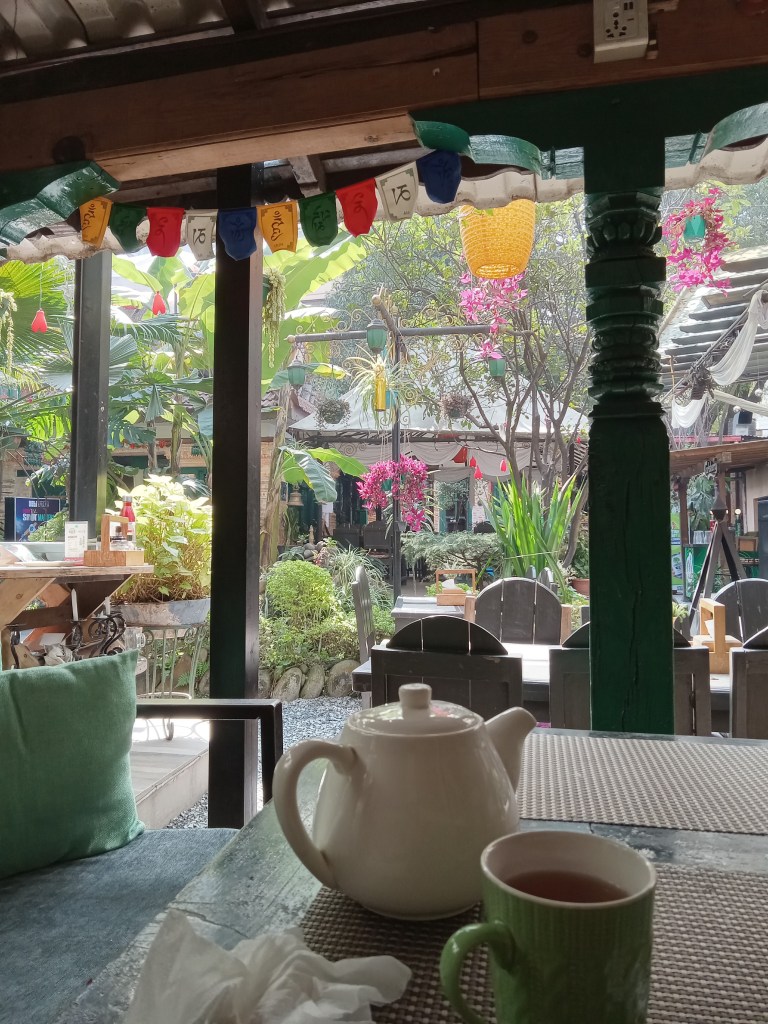
Enjoyed your post and as a regular visitor to Kathmandu I’m intrigued about where your image was taken?
TBH I am not sure I remember where exactly – one of the many inner courtyards in Thamel! Might’ve been this one? https://maps.app.goo.gl/51mzLL47xs2j8MK48