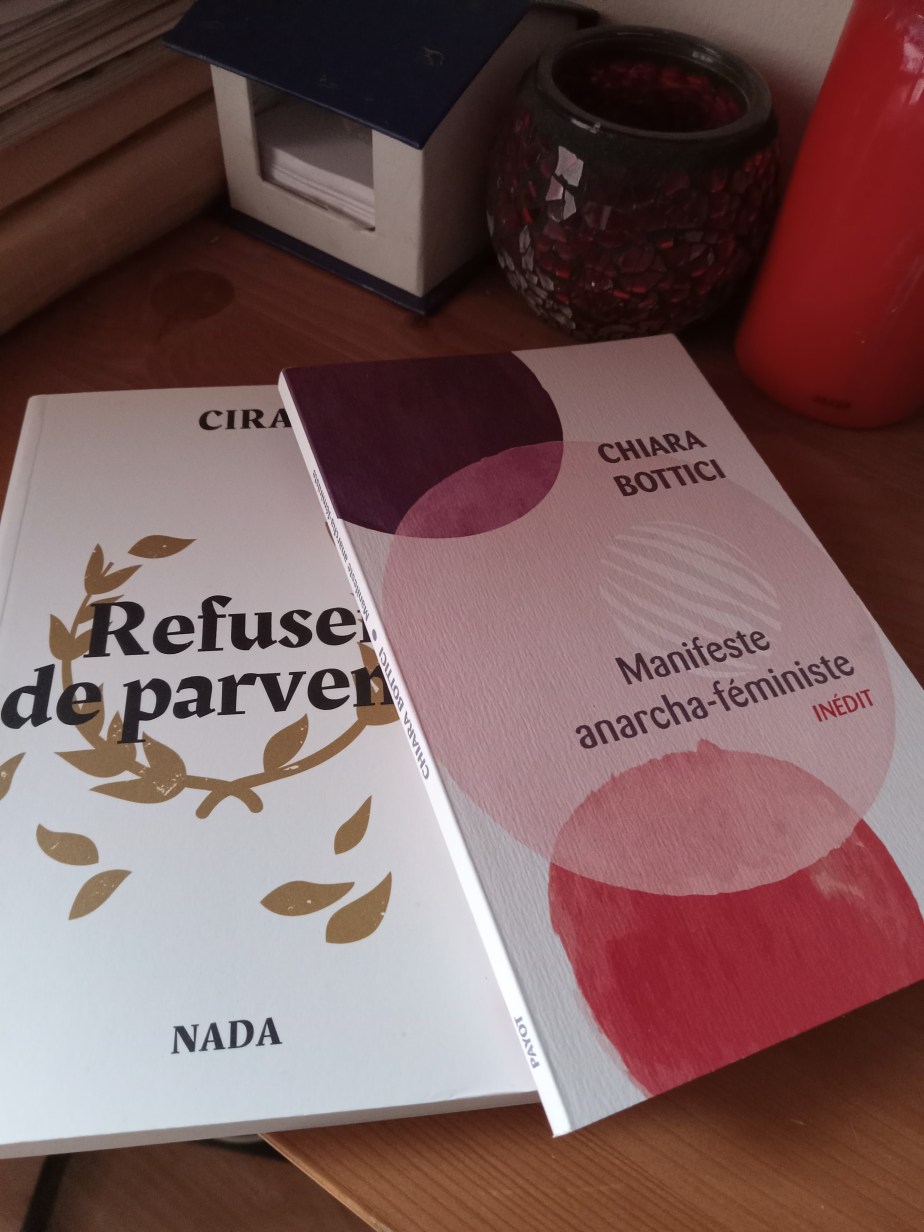
Books in 2025

If you read my blog, you’re probably familiar with my (attempt at a) tradition to post the most meaningful books I’ve read in the preceding year. I started this in 2021, when – not least connected to my work on epistemic positioning and the differential valuation of people who do not fit a particular ‘type’ of epistemic subject – I wrote about the year of reading only (or almost-only) books written by women and non-binary authors. I did the same in 2022. At the end of 2023, I was too burnt-out to write anything (my first – and so far only – Covid infection happened at that time, but it was only the crown of a pretty hellish year by most if not all standards); in 2024, I went back to the habit. I was in Belgrade, inspired by what was at the time a student occupation (of the building, and institution, that was my alma mater), and would grow into one of the biggest student-cum-civic movements in the region (I’ve written about it here and on multiple instances here, if you read Serbian/Croatian/Bosnian etc.). I wrote about books that gave me hope, a term I was never fond of and mostly did not use. And, of course, the events I witnessed in the subsequent year taught me to recognise and take it seriously.

I made up for one ‘missed’ year in February 2025, watching, from California the rapid (if not unforeseen) hostile takeover of the US, in particular the stepping up of immigration policing, and the (not-unrelated) crackdown on universities and, in particular, student protests. I wrote on books about resistance; not because I thought I had anything special to teach people on the ground, but because I was aware the Good Liberals of Social Media (likely most of my readership, though it’s possible I’m underestimating comrades) were comparatively under-prepared and inexperienced in dealing with *that* level of state collapse. There are both consequences and constraints to teaching people some of these skills at a practical level, so I thought the easiest and most useful thing to do, in the short term, is to share those written resources that were available internationally online.

Prior to that, however, I’ve made another decision. That decision had something to do with the process I’ve part-narrated here, but it also had something to do with the realisation that reading is a political act. Not in the self-aggrandizing, performative-intellectual mode that many still take for granted, but in the sense that the gift of attention is, truly, the most scarce resource. Thus refusing to dedicate it to either intellectual fads or resources considered de rigueur in a discipline (or, needless to say, the slop – AI-generated or not – on social media), and training it instead on something else is likely to produce unforeseeable consequences.

In other words, I only read books on anarchism.

Confession: I grew up anarchist, at least as far as early (very, shockingly early) drive towards autonomy and resistance to authority (which also led to multiple clashes with its institutions, something that should be a subject of a very different post) is concerned, but – until very recently – I rarely called myself one, not only because of believing (to paraphrase David Graeber) in the primacy of practice, but also because I have an innate dislike for fixed or stable “identities”, especially of the sort that trigger White Bros to either engage in (unsolicited, what else) “yes but” or approach with (pseudo-)questions like “but how would you solve the problem of [XYZ]?” (itself a reflection of the fact that they see every anarchist as Spokesperson for Anarchy, which betrays their assumption that every movement is in fact a PR operation). I read stuff on anarchism quite obsessively in my late teens and in my undergrad, haphazardly coming across random books, zines, and pamphlets then websites generated by Yugoslav/Serbian impressive plethora of publishers, organisations, distros, and samizdats, but it never made it into my ‘official’ academic portfolio (well, at least not as far as ‘formal’ references go). One part of it is the fact that anarchism is almost by definition opposed to academic conservatism, parochialism, and hierarchy; anarchists also tend to spur ‘scholarly’ publications and write instead for newspapers/magazines, zines, and blogs. Save for a few specialised corners of political thought, anarchist authors hardly ever make it into ‘the canon’. Of course, I quite inevitably read very much outside of the canon (and against it), but I was also socially aware enough to realise that trying to convince someone of the comparative value of Emma Goldman was not a particularly legit move in the academic establishment.

Also, I didn’t care. I never experienced the sort of academic (if only!) para-idolatric reverence some people feel for certain authors. Which is to say, I think there’s a lot of superb, really-relevant, useful writing that can be identified as anarchist (not all of which is signed by individual people, or at all, by the way), and I think there’s a lot of superb, really-relevant, useful writing that…isn’t. I read both; it has been my experience that, by and large, people are as inclined to ignore anarchist authors as non-anarchist authors, providing they are not white men. There are multiple ways to practice epistemic justice; in this process, the ‘how’ can be more important than the ‘who’.

Also, I forgot. By ‘forgot’ I mean that, having absorbed most of the writing available to me between 2000 and 2005, I moved on; carrying the little set of core values mostly unchallenged, not because I had the opportunity to act in accordance with my beliefs, but because I rarely had the opportunity to act in a way that made it clear how much they diverged from most of the orthodoxy. When I did, I systematically made choices that, sometimes incomprehensibly to myself, refused the hierarchy, authority, alliances, and rewards that, as someone pursuing a ‘career’ in the academia, I should have wanted. Of course, I also occasionally made – forced myself to make – other choices. This broke my heart; I swore never to make such choices again.

It’s easy to forget who you are. Academia makes it even easier, also, on occasions, providing you with extensive literature (and sometimes even academic posts, and promotions) that do that. This is what critics of ‘identity politics’ never get: it’s not (well, most of the time) individual people who play the politics. It’s institutions.

Deciding to willingly read only anarchist literature, then, was not only a way to reject the intellectual enclosure, sorting, and ordering that the academia never stops performing. It was also a way to train my own mind to be more open, courageous, and frank about what I think matters. To accept having to risk 1,000-word attempts to explain Marxist theory, or class politics, or the history of the Commune to me (it’s amazing how men never get tired of explaining things others already know about). Admittedly, it was also helped by the fact my current research engages explicitly with the anarchist intellectual tradition; that, too, was a choice.

More than anything, it was to dare to read not only outside of the academic but also of the anarchist canon; to refuse, consistently, to engage in the discussion about Did Kropotkin Really Mean That (you’d have to ask Kropotkin, and thanks in advance for informing me he is long passed, I totally did not know that); to focus on the practical, even if imperfect (nothing practical can ever be perfect) at the expense of the academically profound, even if writing is clumsy, to violate the academic canon of writing perfectly-formed, short sentences, with exactly the right balance of obtuseness and simplicity.

To disobey, terminally and forever, the enclosure that the academia seeks to perform on each and every one of us.

So, this year, I am daring you to do the same.

Refuse loyalty to the disciplinary, professional, intellectual, cognitive framework you have been raised in.

Refuse to perform ‘disloyalty’ by abundantly posting about your reading escapades, one Taschen catalog after another, one mainstream academic press publication after another, each with hefty royalties to the (star) author.

Refuse the fear of coming across as ‘simplistic’, or ‘uneducated’ (yes, academia makes you horribly under-educated, but not in the way you think), or ‘not sophisticated enough’; read for actual knowledge, read for pleasure, read for joy, read for hope, read for anger, read for vengeance, but most of all, stop reading only for yourself and whatever senescent gods of the intellectual realm you (still) serve and start reading for others, those who are alive, those who need it and cannot do it (either because they do not know the language or the jargon or are too misled by social media slop or are hungry or cannot read at all or are busy fighting fascists, feeding kids, getting arrested, burning out, trembling in face of the future, or have been systematically untaught to think and thus also to read) for themselves, or those who are yet to come, and who will be raised in a world of techbros’ dreams, where AI slop has successfully drowned out not only the capacity to think, but the memory of what that felt like.

Start now, and, as Crimethinc framed it, start everywhere.

(You will have probably surmised by now I am not going to give you specific books or reading suggestions. Feel free to start from your own gut – you can read short zines, pamphlets, how-to guides, or you can read classics like Silvia Federici’s Caliban and the Witch, Kropotkin’s Justice and Morality or The Conquest of Bread, or, of course, any mix thereof).

Here are some good places where you can access heaps of anarchist (and related) writing – and for free:

https://theanarchistlibrary.org/category/topic

https://libcom.org/

https://crimethinc.com/library

https://workingclasshistory.com/

https://www.marxists.org/ (yes, obviously, not all Marxists etc., but there are quite a few good resources here)

There are also several anarchist presses/distros (and it is always worth going to an anarchist bookfair if one is available in your part of the world, or going to the local infoshop/radical bookshop in your area).

On books and hope (2024)

This is the continuation of the habit I have kept for a few years, which is to write a post on books I have read that year. That said, “habit” is hardly a deserving name for something I did two years I a row – in 2021 and 2022 – and then dropped in 2023: the year had been too filled, both with ups and downs, and the context in which I read some of those books too convoluted; it is also possible I read more than I usually would (having been on research leave in spring) – or less. I wouldn’t know, as I gave up on keeping a list; I gave up on many other things, including possibly the last vestiges of ego-investment in the academia, which also meant I gave up on reading for competitive, pedagogical, or perfunctory reasons. In this context, coming up with a list of all the books I have read would have seemed a bit counterperformative; not least, the time I would have normally spent writing up this post – the quiet days after the end of term, as Xmas and New Year drag themselves over the hill – was spent flat out from Covid (which I finally caught, one and so far only time) and the ongoing pressure at work.

This year, I am coming back to this, but in order to share the books that brought me hope. This may seem like an odd choice for someone whose approach to knowledge always emphasised the ethical and political responsibility of recognising tendencies in the present that may lead to harmful and disastrous futures – even if that entailed coming to terms that, in not-insignificant ways, our present (in)action may be rendering certain kinds of futures impossible. This, for most of my life – starting with the rather famous moment when, aged eight, I argued to my father that Yugoslavia will fall apart – meant having the courage to be a ‘killjoy’, not only (or primarily) in terms of disrupting the cozy consensus that scaffolds some of the most odious things about contemporary social life – consumerism, patriarchy, xenophobia and racism – but also by pointing out, ceaselessly, that bleating starry-eyed about the revolution to come was, in very real ways, preventing us from bringing it about.

To toss the concept of ‘hope’ about might, from this perspective, seem at best a concession to sentimentality, in the same way in which I dutifully bellow ‘Merry Xmas’ back at people; at worst, like capitulation to the abscondence from the daily work of not reproducing the same systems that we (so eloquently) critique, which intellectuals of my sort are prone to, especially when we reach a certain career (st)age. I, at least, have always swatted away questions of hope or ‘exit’ (as one of my PhD examiners exasperatedly sighed towards the end of my viva: “Then there is no Aufhebung?”), in the same way in which I used to swat away questions of the sort of ‘What is to be done?’ before I decided to start doing less of knowledge production and more of…other stuff.

Why hope, then? Put simply, one of the rare justifications I find nowadays for continuing to do “academia” is that (nominally, at least) it entails two things: time to read (one might say, an obligation) and a platform to tell others so (as well as what not to read). And everyone needs a bit of hope. This is particularly important as I see growing numbers of (even educated) people fall for trash arguments along the lines of Stephen Pinker’s ‘Better Angels’ or other kinds of Pollyanna-ish optimism that usually serves to bolster capitalist, extractivist, or neocolonial approaches to ‘business as usual’. Thus, to be able to see ‘hope’ without, at the same time, ‘unseeing’ all things that render it impossible (the war in Gaza; continuous extraction; runaway climate crisis) becomes a difficult exercise in discernment and balancing – something that, in fact, academics of my sort are uniquely trained to do.

That said, not all of the books included in this list count as ‘academic’ – and most would not But they are what sustained me over the past year. I hope they can be of service to you.

Revenant ecologies: defying the violence of extinction and conservation (Audra Mitchell)

This is a book that challenges powerfully the thinking about extinction and conservation that dominates Anglo-academia. Particular points for taking a swipe at the ‘extinction industry’ of academic writing, and the books (many of which I admit I had enjoyed!) that write about extinction from a seemingly universalist perspective. On the other hand, Revenant Ecologies seems at times to take almost excessive care to avoid this. Regardless, it is a careful, engaging, and mobilising analysis that aims to avoid the po

As we have always done: indigenous freedom through radical resistance (Leanne Betasamosake Simpson)

I’ve admired Betasamosake Simpson’s writing for a long time (and also music! How cool it is to be a social theorist who also writes and performs music). This book is a reminder that undercurrents of resistance run deep, but also that freedom is a praxis – a constant one, at that.

Our history is the future: Standing Rock vs. the Dakota Access Pipeline, and the long tradition of Indigenous resistance (Nick Estes)

QED. Well, maybe there is a bit of a theme running through this year’s reading. But in a year that felt so long, and hopeless, and dark, I needed (printed) reminders that people have lived through (and survived) worse ordeals, and that they not only did not accept but actively challenged and fought against the colonial order and its successors, including extractivism.

Ecology of wisdom (Arne Naess)

Naess is one of those people who are larger than history gives them credit for – he is usually styled as the ‘founder of the deep ecology movement’, but Naess was a philosopher (prefiguring a lot of analytical thought), an ecologist, a spiritual thinker (a Buddhist and firmly committed to nonviolent action), and a mountaineer. ‘Ecology of wisdom’ is a compendium of his writings; thanks, in part, to masterful translation, the prose just flies off the page making it more like poetry (I’ll admit that the combination of analytic philosophy, Buddhism, and ecology is particularly likely to chime with how I feel and think about the world). Nonetheless, I find it hard to think anyone would not be charmed – at least anyone who still has a heart, and soul, in some part of the magical world we inhabit.

And if you need a reminder how to (re)discover it, these two are highly recommended: Reclaiming the wild soul (Mary Reynolds Thompson) and  Enchanted life: reclaiming the magic and the wisdom of the natural world  (Sharon Blackie). I *really* like Sharon Blackie’s writing – it manages to be equal parts environmentalist, witchy, psychoanalytic and folksy without becoming too bound by conventions of any.

Foxfire, wolfskin: and other stories of shapeshifting women (Sharon Blackie) is a wonderful retelling of some of the classical European folk tales, with a gender twist that does not come across as pedagogical. I absolutely adored it – and even got it for a few friends.

A natural history of the future (Rob Dunn)

This is a great (admittedly, popular science) book on the impacts of the ongoing climate change and other human-induced changes on the biosphere. It brings in new arguments and perspectives, even if you’re a seasoned reader of the genre, and I’d say it’s informed by deep ecology whilst retaining a pleasantly matter-of-factly tone.

Claros del Bosque (Maria Zambrano)

I used the two unforeseen trips to Serbia in springtime to delve into the rich body of non-English philosophical and theoretical works in translation, something I dearly miss in bewilderingly anglo-centric UK (even major works in French or German are increasingly translated with a delay, if at all). I chanced upon the Serbian translation of Zambrano’s Claros del Bosque (forest clearings? ) in one of my favourite (independent) bookshops, but given that 2024 was also the year in which I decided to refresh my Spanish, I also got the original (the combination proving the right level for my Spanish reading skill). Zambrano (a metaphysician, essayist, and Spanish republican) was yet another ‘forgotten’ philosopher whose work I enjoyed discovering in the past two years, alongside Anne Dufourmantelle and Mari Ruti; her writing also reminded me of Clarice Lispector, with the combination of the poetic and the philosophical.

Drive your plow over the bones of the dead (Olga Tokarczuk)

I returned to reading Drive your plow…late this year, after a chance encounter on the plane this spring reminded me it was one of the (many) books I had been meaning to come back to. Let’s just say I do not regret the decision: it also linked to the research project I will be working on over the next year and a half – which just goes on to show things tend to come back at exactly the right time.

The Dawn of Everything: A new history of humanity (David Graeber & David Wengrow)

One of the wonderful things about my new research project was returning to the things that excited me about anthropology as an undergrad, including its ability to challenge large-scale (often Eurocentric) generalisations. In this vein, I’ve started reading Graeber and Wengrow’s The Dawn of Everything, which I’m currently enjoying very much; the only downside being that I am beginning to fear they may have already written the book I had been planning to write as the outcome of this research project – but yet, it’s a good problem to have, and I am sure I will still have something to contribute.  

Fields, factories, and workshops (Peter Kropotkin)

Another wonderful corollary of this research project is that it allows me to revisit multiple traditions of writing that were foundational to my thinking as an undergrad – not only anthropology, but also (classical) anarchist political theory. In this context, I am (re)reading Kropotkin’s Mutual Aid; given how much anarchist political theory has been discounted and undervalued, not only in mainstream political theory, but also among more progressive forms of reading, this will hopefully play a small part in restoring interest in it.

We do ‘till we free us: abolitionist organizing and transforming justice (Mariame Kaba)

Kaba’s writing is by now semi-legendary, but it also makes sense to remember that it is very down-to-earth, and that it arose from the lived experience of day-to-day abolitionist organising. In the UK context, in which the absence of sustained resistance to forms of exploitation old and new can be dispiriting at best, it is a reminder that forms and practice of resistance do exist elsewhere, and that it’s possible to learn from them.

Climate strike (Derek Wall)

Wall’s book is a really good primer on the relevance of labour organizing, and industrial action, in the face of climate crisis. It is also a potent reminder that problems of climate change and extractivism cannot be addressed separately from questions of labour, which is a much-needed aid in the political context where connecting the two can sometimes feel like an uphill battle.

We are ‘Nature’ defending itself: entagling art, activism, and autonomous zones (Isabelle Fremeaux and Jay Jordan)

This is the story of the French temporary autonomous zone (ZAD) developed at Notre-Dame-des-Landes to stop a proposed airport. More than that, it’s a story about resistance and resilience. It’s a story that tells us that the machine can be stopped.

Constellations of care: anarcha-feminism in practice (Cindy Barukh Milstein)

This is a great compendium of examples, texts, and experiences from different fronts of feminist, queer, and other kinds of intersectional anarchist organising. From infoshops and free libraries to community health initiatives to bike riders, these stories remind us that the world is full of examples of communities existing otherwise, sometimes for longer, sometimes for shorter periods of time, but often all it takes is a few people, a few good ideas, and a commitment to not give up ahead of even trying, to make a lasting contribution to a different world.

Radical Intimacy (Sophie K. Rosa)

I have a long-standing interest in alternative models of relationality (‘alternative’ meaning all that do not privilege heteropatriarchal, monogamous couple-based, reproduction-oriented family) so most of the arguments Rosa writes about are familiar – from Kim TallBear’s writing about non-settler-colonial-normative Indigenous modes of relating, to Sophie Lewis’s take on family abolition – but it is refreshing to see them presented in a succinct, carefully analysed, and user-friendly format. Especially for people who are new to this angle of critique, it’s a really welcome introduction; for others, it’s a handy compendium/reminder of the plethora of the ways in which humans have been relating otherwise – and a powerful primer for ongoing and future attempts to do so.

One of the last books I came to in 2024 (am, in fact, still reading) is also one of the best – Vanessa Machado de Oliveira’s Hospicing Modernity. Earlier this year, prompted, in part, by the war in Gaza and, in part, by the need to explain some of the choices I made in the course of it – including the decision to redirect more of my energy into the activities, goals and values I support – I wrote two posts [1] [2]; let’s just say that reading Machado de Oliveira’s book earlier would have saved me the labour, as she wrote it much better than I ever could.

The penultimate item on the list is not a book, but a magazine – Resurgence & the Ecologist, which I eventually got a subscription for, despite trying to talk myself out of it (youdontneedfeelgoodmagazinesubscriptionsthisisjustmorepapertheworldisonfire) – after all, it is much better than buying The Economist, even if very occasionally.

The final publication of this year, however, is a pamphlet I encountered while visiting one of the student occupations in Belgrade – it was a delight to see it both because I always enjoy CrimethInc materials (returning to reading more anarchism is probably one of the most healing things I have experienced this year) and because I think they are enormously useful for succinctly reminding people why things feel very, very wrong…and what we can do about it.

Happy New Year!

Books this year

At the end of 2021, I published a list of & short commentary on the books I had read during that year, partly to amplify books written by women (and non-binary) authors, partly to highlight the persistent (and intersectional) process of devaluing, ‘forgetting’, or unknowing work written by women. This list is shorter; not all books are by women/NB authors (though most are), and I also wrote several blog posts (and articles) that engage with some of the work listed here in more detail (if you’re after that sort of thing). Judging by the length of the list, I read less (some of this has to do with general exhaustion/burnout, and some with other stuff that was happening in the year, including funding deadlines, running a new project, and leading EDI in my Department). I also like to think I read deeper.

Clare Mac Cumhaill and Rachel Wiseman, Metaphysical Animals: How Four Women Brought Philosophy Back to Life

This eagerly anticipated book not only covers some of my favourite philosophers (Anscombe; Murdoch) but also presents a carefully executed study of the social and historical setting of Oxford (‘ordinary-language’) philosophy, so 10/10.

Oh, I’ve also read the other book on the Anscombe/Foot/Midgley/Murdoch ‘quartet’ that came out, only to check whether there was any accuracy in (multiple) reviewers’ perennial tendency to ascribe analytical acumen to books written by men, and ‘biographical’ and ‘descriptive’ detail to books written by women (which is in and of itself a kind of epistemic injustice/epistemic positioning, by the way). There isn’t. Thought so.

Christine Korsgaard, Self-constitution: agency, identity, integrity

It is perhaps a truism that if you start doing moral philosophy you never stray too far from Kant. True or not, this book was probably one of the best ways to come back to it. As I’ve written in a blog post that engages with the book in slightly more detail, over the past couple of years I have become increasingly interested in problems of normative theory – something I’ve been strongly opposed to most of my career thus far (I even wrote a PhD on why we’re prone to confuse epistemic with moral and/or political sentiments). Korsgaard’s approach to theories of identity and agency is decisively contemporary and has significant implications for how we think about the ability to choose, so it fit the bill perfectly. It is also one of the books that confirm the rule that women philosophers tend to write better than most people.

Sheila Jasanoff et al, Uncertainty

Disclaimer: I actually have a chapter in this volume, initially developed as a forum response in Boston Review (the text is part of my broader work on agency, unknowing, and resistance). I think all contributions are worth reading because they reflect the general debate about knowledge, prediction, and what science can do – and thus both its highs and its lows.

Michelle Murphy, Sick building syndrome and the problem of uncertainty

Speaking of uncertainty: I think I initially started re-reading Michelle Murphy’s famous monograph last year because of my work on Covid-19 and institutional forms of ‘unknowing’ when it comes to things such as airborne spread. Reading it, I was reminded not only how brilliant, well-written, and pioneering Murphy’s work was, but also how institutional ways of ‘unknowing’ function when it comes to access to knowledge: namely, none of the libraries of the institution I work for have this book in physical form (it is accessible in online form), despite its pioneering status in the fields of public health, STS, and policy studies, all of which the institution specializes in. The availability of physical books in the library means students may encounter it just by browsing the shelves; books available online only get discovered if already assigned to the syllabus, which already requires someone (someone in a position of power, at that) to recognize and validate the book as key, mandatory, or at least relevant. Really makes you think about the materiality of objects, that.     

Michelle Murphy, Economization of life

Once on a Murphy roll I kept going, so I bought and started reading (for the first time) Murphy’s 2017 Economization of life. It chimed well with the piece on ‘slow death’ (building on Berlant), as well as with a few other pieces on bio- and necro-politics I was writing at the time, but its emphasis on reproductive rights and reproductive justice was also a 10/10 in the year in which the US Supreme Court struck down Roe vs. Wade.

Max Liboiron, Pollution is colonialism

OK, full disclosure: I read most of this book in 2021 but it is so good I wanted to feature it again and in more detail. Actually, detail aside: this is simply the best book to read if you are doing any sort of scientific work. Or activism. Or politics. Or just, you know, living in the vicinity of institutions of knowledge production. Just read it. Seriously.

Cara New Daggett, The Birth of Energy

This is a really good example of a careful engagement with arguments in history, political economy, and sociology/anthropology of science to make a simple but often overlooked point: the construction of much of contemporary world required the translation of different sources – raw materials, human labour, and knowledge – into energy. In addition to the reproductive politics in Murphy’s book, it was also a reminder of how much of everyday existence depends on humans just willing themselves (or being willed to?) do something.

Martha Nussbaum, Therapy of desire: the theory and practice of Hellenistic ethics

Nussbaum was one of the first philosophers I grew to like on the question of morals and ethics; this book was, in a manner of speaking, a stand-in – I wanted to buy Upheavals of Thought, which I had started reading in the (first) winter break of my (second) PhD, but couldn’t afford it in 2015, so went for this one instead. Revisiting it recently was both an uncanny experience – I was reading marginalia from my 7-years-ago-self – and a reminder of the origin of some of the key theoretical questions I grappled with and would go on to shape my subsequent intellectual project, including the role of theory in relation to practice.

Joanne Barker, Red Scare: the state’s indigenous terrorist

Thanks to Sakshi who I think first mentioned this book on Twitter. I’ve always had an interest in settler-colonial histories, including that of United States (this was, by the way, part of my undergraduate training in anthropology 2000-2004 at the University of Belgrade – you can imagine my surprise at the realization that histories of colonization are still considered ‘controversial’ and/or are not taught in many ‘Western’ universities); Coulthard’s Red Skin, White Masks was a formative influence on my book on politics of class and identity in former Yugoslavia, and Mamdani’s Neither Settler nor Native is one of the best books I’ve read (and keep reading) in the past three years. Barker’s book joins this lineup with a thorough take on the criminalization of indigenous resistance – something that has profound implications not only for how we think about projects of decolonizing, but also about ecological activism.

Maggie Nelson, Bluets

Speaking of reading via friends: I know and like Nelson’s work (I started reading On Freedom in 2021 despite forgetting to include it in the blog post!, and have started reading The Red Parts last year), and I’ve wanted to read Bluets in a while. The opportunity finally presented itself when I visited Marina Veličković’s flat in Newcastle, where I found it on the shelf (yes, sorry, I know I have said this already, but having me in your flat means I will read your books). Promptly purchased my own copy and read it after moving to a (rather blue) house on the North Sea coast.

I have read William Gass’ On Being Blue in 2014; blue, and versions of, are effectively the only colour palette I like (the rest of my choices, both in terms of wardrobe and in terms of environment, oscillate in the triangle of black, white, and [shades of] grey). But I love almost all shades of blue; and, of course, the sea. Though, of course, that could just be a trick of the light, st(r)uck in the same triangle between white, black, and grey.

Adam Phillips, On Getting Better and On Wanting to Change

Adam Phillips is my sort of guilty pleasure (and, of course, one of my favourite books by Phillips – in addition to On Flirtation – is Unforbidden Pleasures). In other words, Adam Phillips is what I read when I feel in need of a self-help book. Last year he published two, and although short (and meant to be read in tandem), I found them quite different – On Wanting to Change seemed like a not-too-deeply developed iteration/repetition of much of his earlier work; On Getting Better was much better (sorry), which came as a surprise as the theoretical focus of the first is generally closer to my sphere of interest than that of the second. Oh, we change.

Adam Phillips, On Flirtation

This is not only one of my favourite books by Phillips, it is also one of my favourite books in general. I was re-reading it after about five or six years – my copy is the specimen some good soul left in the ‘books to adopt’ section in the old Cambridge Sociology PhD attic – and marvelling at how little I remembered of the original reading.

Adam Phillips, On Kissing, Tickling, and Being Bored

What can I say, I needed a lot of self-help this year.

Lauren Berlant, On the Inconvenience of Other People

I eagerly anticipated Berlant’s last book (technically, finished and published after they had already passed) and so far it does not seem to disappoint. The last couple of years have been, for me, marked to a rather significant degree by reading (and teaching) Berlant’s work, and since this special issue on ‘Encountering Berlant’came out towards the end of the year, I am looking forward to continuing to engage it in the things I am writing at the moment.

Simone De Beauvoir, Ethics of Ambiguity

During a particularly dark period last year, I started re-reading de Beauvoir’s Ethics of Ambiguity, which I’ve first read during my PhD (in which ambiguity features rather prominently). Back then, of course, I read it primarily as an argument in existentialist ontology; this time around, I paid more attention to the ethics aspect, which is exceptional – but, as I kept thinking, also relevant for contemporary discussions, somewhat archaic language aside. Given that I’ve spent years entreating people to read Ethics of Ambiguity (the usual response, of course, being “oh I haven’t read it” – most people who claim to have ‘read’ de Beauvoir have barely made it past the first 20 pages of Second Sex; this form of sidelinining/domaining is something I’ve explored here), I decided to bite the bullet and asked online if anyone would be interested in a reading group – so far it’s at its third iteration, so you are more than welcome to join!

Sally Rooney, Beautiful World, Where are you?

I’ve written about Rooney’s third book (as well as a related novella, Mr Salary) in more detail here. Given I really liked Conversations with Friends (a book I picked up on a whim, based solely on its cover and the fact I was given some book tokens in exchange for keynoting at a conference, and was determined, deep in the throes of writing my PhD, to spend them on fiction rather than theory) before Rooney became A Name, and given I did not really like Normal People after it, I was apprehensive about this one. I really struggled with the first three quarters (or more like 5/6ths), but it picked up towards the end, making me think that there might have been something about my own pace of reading/processing at the time that it mimicked or repeated.

Margaret Atwood, Penelopiad

Atwood *and* Classics, furthermore Odyssey? Yes.

Maria Tumarkin, Axiomatic

“The past shapes the present—they teach us that in schools and universities. (Shapes? Infiltrates, more like; imbues, infuses.) This past cannot be visited like an ageing aunt. It doesn’t live in little zoo enclosures. Half the time, this past is nothing less than the beating heart of the present. So, how to speak of the searing, unpindownable power that the past—ours, our family’s, our culture’s—wields in the present?”

‘Axiomatic’ was the first of two books I picked up in Durham’s newest independent bookshop (outstanding collection of books plus a reading nook, coffee/tea and cake). Obviously, I was drawn by the title, but it turned out I couldn’t have picked better – Tumarkin is an Eastern European living in Australia (in her memorable phrase, from ‘Eastern European elsewheres’), and reflecting on commonplaces of moving, learning, knowing, and forgetting (including trauma), in a mix of fiction, reportage, and analysis. Let’s just say I left the book with my therapist.  

Radmila Zygouris, Pasji život u bundi od samurovine i drugi psihoanalitički slučajevi (L’Ordinaire, symptome)

Speaking of both psychoanalysis and immigrant trajectories, I also read this book, translated into Serbian by one of my mum’s oldest friends. It is composed of articles and interviews with a prominent French Lacanian analyst – now in her 1980s – Radmila Zygouris, whose story (and career) combines Greece, Serbia, Argentina, Paris and Germany (!!). The book is sadly not available in English, but the closest edition is in French, here.  

Jelena Nolan Roll, O blokovima se priča (Storytelling from New Belgrade Blocks)

It’s great when one of your best friends publishes a book; it’s even better when it turns out that the book is really good, a half-magic-realist allegory of growing up in New Belgrade’s equivalent of council house flats in 1990s and early 2000s. The book is so far in Serbian only; there are book launches scheduled for Bristol (where Jelena resides) and London, so perhaps the English translation is not too far off…?

Hella Pick, Invisible Walls: A Journalist in Search of Her Life

This is the other book I picked up from Collected on a late-November strike-day attempt to recover from the combined pressures of Autumn darkness and term-time exhaustion. Pick was, for a significant part of the second half of the 20th century, The Guardian’s diplomatic correspondent. She was also on the Kindertransport from Austria. The story in between weaves together some of the most interesting parts of contemporary history (including early stages of decolonization, the formation of the Non-Aligned Movement, and the Cold War) and reminded me again – as I discovered in 2021, when reading Deborah Levy – that biographies are only boring if written by men.

It would have been great to close this year (and post) in oh-so-circular a fashion, with a biography (Pick), but sadly neither is Metaphysical Animals (only) a biography (it is, indeed, philosophy) nor are lives, blog posts, or books ever (fully) circular, so here’s instead a meta-reference to this – as well as to the book with which I closed 2020 and started 2021, A Tale for the Time Being:   

Ruth Ozeki, Book of Form and Emptiness

I have (really) started Ozeki’s newest earlier in 2022, and have (really) picked it up again only in the last days of 2022, and I (really) so far like it less than A Tale, but given that (I hope) it is – in addition to a book that is also about itself – a meta-reference to Kundera’s Book of Laughter and Forgetting, here’s to…well, not forgetting.

‘Ethics of Ambiguity’ Reading Group

This is a reading group for all those who wish to come together to discuss Simone de Beauvoir’s “Ethics of Ambiguity” (1947).

The group runs in (Northern hemisphere) winter 2022-3, mostly coinciding with the winter break, and is designed to give space for open reflection and discussion of ideas concerning ethics, responsibility, and ambiguity in relation to contemporary circumstances.

The group is open to all. Philosophical training or detailed background knowledge are not required. For specs, see FAQ (1) below.

The group runs in weekly sessions on Zoom, Fridays 1-2PM (BST, London time), starting from 16 December until 27 January inclusive of Xmas/New Year’s break. This time is chosen both for accessibility purposes and, in some cases, to accommodate the academic term. If the timing does not suit you, please see FAQ (2) below.

For instructions on how and when to join, as well as how to participate, see FAQs (3) and (4). For schedule, see bottom of page.

FAQs (or, please read this before joining):

(1) Who can participate?

The group is open to all. You do not need to have a philosophical background, detailed knowledge of existentialist (or any) philosophy, or an interest in Simone de Beauvoir to participate. The group welcomes all people regardless of gender, ethnicity, ability, or any other aspect of identity; that said, the conversation is designed to be respectful and equal, so bullying, racism and transphobia will not be tolerated.

There is no formal leadership and no assumption of authority in the group. The emphasis in the discussion is on personal impressions, thoughts, and questions that the text raises for you. That said, be mindful of the background of participants when contributing; do not use references (as in, ‘in her other work, de Beauvoir…’) or name-drops (as in, ‘as Foucault said..’) without explaining what you mean in a language accessible to everyone (or, best, skip name-dropping altogether).

(2) What if the timing does not suit me?

The group is run on an entirely informal and voluntary basis. You are free to join any of the sessions at any time between 1 and 2 PM, without expectation of continuation or repeat participation. If the timing does not suit you, you are welcome to start another reading or discussion group at a timing that suits you better.

(3) How can I join?

Below is the schedule, Zoom link, and details for each session.

16 December, 1-2PM (BST)

Chapter 1: Ambiguity and Freedom (pages 5-35 in 2015 English edition by Open Road Integrated Media)

Join


23 December, 1-2PM (BST)

Chapter 2: Personal Freedom and Others (pp. 37-78, as above)

Join

[Winter break]

6 January, 1-2PM (BST)

Chapter 3: The Positive Aspect of Ambiguity, Sections I (The Aesthetic Attitude) and II (Freedom and Liberation), pp. 79-103

Join

13 January, 1-2PM (BST)

Chapter 3: The Positive Aspect of Ambiguity, Sections III and IV (The Antinomies of Action & The Present and the Future), pp. 103-139

Join

20 January, 1-2PM (BST)

Chapter 3, Section IV (The Present and the Future), cont’d, and beginning of Chapter V: Ambiguity (pp. 139-168).

Join

27 January, 1-2PM (BST)

Conclusions (pp. 169-174) and wrap-up/further plans

Join

(4) How do I participate?

Be mindful of other participants. Try not to take more than 2-3 minutes when speaking, and give priority to those who have not already spoken in the meeting. While there will be no chairing or official moderation (unless absolutely necessary), raising your hand (Zoom lower bar in window –> Reactions –> ‘Raise hand’) function will signal to other speakers you want to speak and indicate your turn in the conversation.

Your microphone will be muted by default when joining. Please make sure you keep your mic on mute except when speaking, especially if in a noisy environment. Participants are normally expected to turn cameras on as this contributes to participation and communication, but we understand there are safety- and ability-related reasons not to do so.

De Beauvoir’s book can be found on Marxists.org (link above), in libraries, or bookshops.

Happy reading!

A Year of Reading Only (Well, Mostly) Women

Whenever someone asks me for my favourite (or top 5, or 10) books of the year, I become aware of the fact that in the last year (and some), I’ve read books only or mainly written by women.

This wasn’t entirely planned. Of course, I was aware of Sara Ahmed’s approach to citational justice in Living a Feminist Life, which entailed citing only women (and recall with amusement the shocked reaction of some of my colleagues to hearing this at Ahmed’s lecture in Cambridge, as if not citing white men constituted the ultimate betrayal of academic mores). But over the past year-and-some, I became increasingly aware of how much erasure of women’s work there is in the UK – in particular in theory. Some of this came through my work on epistemic positioning; but, like the concepts developed in the article, most of it came from participation in academic and other intellectual environments. I encountered social theory syllabi where barely any women were present (and if they were, they were all grouped in the incongruous pile called ‘feminist theory’ or ‘gender’, just like Black and minority ethnic scholars were to be found under ‘studies of race and racism’ and nowhere else); I saw special issues of academic journals on rather general topics that would feature articles only by men.  

As someone who read lots and indiscriminately, the absence of women – even those run-of-the-mill, obligatory ‘passage points’ like Arendt and de Beauvoir – truly stunned me. My own work gave me a good sense of how and why this was happening; but it left me none the wiser in terms of how to change it beyond the remit of my teaching. When it came either to reading/referencing recommendations or course design, I found myself mentioning or encouraging people to read women authors rather than just the ‘usual suspects’ White men. More often than not, it would turn out that people were in fact aware of the book/author, or at least had heard of them, but had forgotten about them, or just never considered them.

This brought to mind the relevance of attention, and time, in the fight for epistemic justice. Of course academics are overworked; as clearly expressed in the strike at the beginning of December, there has been a constant workload creep in the UK academia. It isn’t only about Zoom and incessant meetings in the first pandemic year, or juggling both online and offline content and growing student numbers in the second. Everyone is struggling. In this context, it is only too imaginable that people reach for the ‘usual suspects’, for the references they already know and have been using for years, rather than look for new (or old!) ones.

It also encourages lazy and reductive reading: of course you’re not going to bother with this book if it’s only about a ‘feminist’ reading rather than, say, about class and labour, or with this as it’s about ‘women’s history’ rather than philosophy. The only innovative thing about such tropes is the ingenuity with which they apply the assumption that ‘(White) boys write about everything, women write about women’s issues’, to a seemingly endless set of authors and topics. 

In this context, my New Year’s present is a list of things written only by women. Some of these have been published in the course of the last year; some of these I have been re-reading for different reasons, often connected with work. Every single time, however, I was struck by the relevance of ideas, the clarity of prose, and, not least – the patent absence of self-indulgence and clunkiness of phrase that so often characterises theoretical writing by men. Not all of these books were ‘theory’, either; there is a good degree of fiction, essays, as well as auto/biography.

Of course I also read some men – most notably when I had to for work, but also when I found pieces really interesting, although in this case as well I privileged men who were not white (two favourites: here and here), or who set good examples on how to cite women (and survive!). Goes without saying I also read non-binary scholars (two favourites: here and here).

So here’s my New Year’s list, with random annotated comments at times, and, roughly, in the order I have read them.

Simone de Beauvoir, Collected Works (2020)

This was a present for my 40th birthday. Given that my birthday took place under a lockdown, five months after I had lost my mother, and pending Year 2 of a global pandemic, this is one of the few things that made it worth it. There are many excellent, previously untranslated, essays here, with analytical prefaces by a range of contemporary readers, which are often almost as good; I read Pyrrhus and Cinéas for the first time (I read French, but have over time become lazy at reading philosophy in languages other than English, something I regret). It is one of the most powerful philosophical reflections on the nature of agency, and it helped me direct my thinking about the meaning of legacy, temporality, and change. Shorter pieces on abortion, Marxism, and colonialism, among others, are well worth a read, for the understanding of the evolution of de Beauvoir’s politics and the range – and influence – her thought exercised in the day (only to be, like many other women intellectuals, erased retrospectively). This edition is the first to fully recognize this legacy.

If you are new to de Beauvoir’s writing, you can start anywhere; if you have access to institutional libraries, encourage your university or institutional library to buy the collected works, and then you can read or assign specific essays. (Un)surprisingly, many students had actually never read de Beauvoir previously – despite being fed ‘post-feminist’ ideas about how feminism was passé.  Wonder why.

Kate Inglis, Notes for the Everlost: A Field Guide to Grief

This book reached me in an envelope sent in the post, together with some (vegan) chocolate, some loose leaf Darjeeling tea, and a note saying ‘Here if you want to talk. Or if you do not. Or just generally here’, reminding me why feminist (and women’s) friendships are, and I use neither lightly, a blessing and a privilege.

Inglis’ book is exactly what the subtitle says. She wrote it after one of the twins she gave birth to never made it out of the intensive neonatal care unit. In some ways, of course, the experience that prompted the book could not be farther removed from mine: Inglis had lost a child; I had lost a parent. But it’s an excellent guide to mourning (don’t worry – no prescriptive ‘five stages’ bullshit here). It also contains one of the most insightful observations I have ever heard: the first moments after losing someone are uncharacteristic because you get to peek behind the thin boundary of life and death; if I recall correctly, she compares it to a heroin high, where you almost feel omnipotent just for being alive. It’s the comedown that’s difficult. I probably owe a lot of preserved sanity to this observation.

Ann Leckie, Ancillary Justice

In addition to dispensing wise books, tea, and chocolate at exactly the right moments, one of my best friends also shares my love of sci-fi, and the corresponding frustration about the lack of good new stuff. I was dispatched from New Year’s visit to her and her partner with Ann Leckie’s Ancillary Justice, which is excellent; I look forward to reading the sequels (Mercy, Sword, and Provenance).  

Chloe Cooper, The Arsonist

Know how I said it’s a privilege to have friends who buy you good books? I was lucky enough to get two of each at the end of last year – Sakshi Aravind and Solange Manche gave me Cooper’s The Arsonist and James Bradley’s Clade. I got started on Cooper, which is set in Australia; my partner borrowed Clade, which I was glad about not only for helping me maintain gender consistency but also because it’s a book about climate change. I look forward to picking up both in the new year!

Jacqueline Rose, Mothers: An Essay on Love and Cruelty

This might seem like it’s repeating the point made earlier, but I in fact bought and started reading Rose’s Mothers a few years back. I only picked up on it, however, after my own mother had died; I read it on and off throughout the year, and having finally completed it, must say it’s excellent. It also made me consider trying to read Elena Ferrante’s Neapolitan novels again, which I started but did not feel compelled by in the slightest. I am an unrepentant longitudinal *and* parallel reader – I often pick up on books years after starting them, much to the chagrin of some of my friends – but that doesn’t mean there aren’t books that I can’t put down.

Judith Butler, Frames of War: When is Life Grievable? and The Psychic Life of Power

I’m not even sure why I started re-reading Frames of War, but I found it – especially ‘Torture and the Ethics of Photography’ – incredibly relevant for the present moment. It’s also now part of the mandatory reading on my theory modules.

Speaking of which: The Psychic Life of Power is Butler’s best book. It’s a shame many social theory syllabi rarely feature Butler’s writing beyond Gender Trouble or Bodies That Matter (if at all); Butler is by far one of the most insightful theorists of power, which enforces my point that she should be read as a political philosopher.  

Kelly Oliver, Witnessing: beyond recognition

It was actually Oliver’s book that inspired me to read The Psychic Life of Power – it is a remarkably comprehensive yet analytical take on the logic of I-Thou, applying it to a range of examples from debates on politics of identity to transitional justice. Outstanding political theory writing. It’s a shame it’s not better known – oh, wait, I have an idea of why that might be the case.

Nancy Folbre, The Rise and Decline of Patriarchal Systems: an Intersectional Political Economy

As Folbre noted in a recent book talk, a probably better title would have been ‘The Rise, Decline, and Rise Again’, given the resurgence of anti-feminist and misogynist politics, policies, and sentiments we are witnessing. Rest assured, however – the book is no friend to the ‘equality achieved, what are women complaining about’ brand of ‘theory’ (for a useful takedown of such theories, see here).  

Francesca Wade, Square Haunting

Wade’s book is part history, part biography, insofar as it details the lives of exceptional women – H.D., Virginia Woolf, Dorothy Sayers, Eileen Power, and Jane Harrison – who all lived in the same area of Bloomsbury around Mecklenburgh Square, but it is both so rich in narrative detail and strong on feminist politics of the day that I used it as bedtime reading. It is also one of my favourite parts of London, which helped soothe the London withdrawal syndrome caused by both lockdown and moving farther away.

Tressie McMillan Cottom, Thick

Another present, this one from my dear friend and collaborator Linsey McGoey – I love McMillan Cottom’s writing and this is a good analysis of how raced (and gendered) assumptions shape dominant institutions’ perceptions of talent and intelligence, told from a biographical perspective. Now that the book made it out of storage, I look forward to continuing it!

Sara Ahmed, Living a Feminist Life and Complaint!

I am a regular reader of Ahmed but this was a fantastic double-bill. The first I re-read because I needed it (meaning, I was using it for an article I was working on); the second I eagerly anticipated. As it turns out, they also provided the framing for thinking about mediating my own personal experience of bullying and gender-based discrimination at work; in this sense, I certainly needed the first, and I am adamant about using the second as a guide for all scholars who are experiencing, or have experienced, these forms of abuse. I have also, with a few others, been discussing/planning a reading group on Complaint! at Durham.

Jacqueline Rose, On Violence and on Violence Against Women

In a year so defined by sexism, misogyny and patriarchy, my second most eagerly anticipated book after Complaint! was Jacqueline Rose’s On Violence and on Violence Against Women. Not sure what specialists would have to say about it, but I was impressed by Rose’s capacity to say something new about a subject that has been extensively written about – and to connect it to the deepest questions of social theory. A difficult book – not for the style, which is excellent and crisp, but for the topic – which I’ve occasionally had to put down, but look forward to completing in the new year.

Adriana Zaharijevic, Life of Bodies: Political Philosophy of Judith Butler

Full disclosure: this book has not yet been published in English, but it is in the process of being translated by Edinburgh University Press. Written by my dear friend and feminist co-conspirator Adriana Zaharijević, it is an excellent analysis of the connections between Butler’s treatment of gender, precarity, and agency, by one of the best Butler scholars today. Incidentally, it also concurs with my reading that Butler is above all a political philosopher.

Katherine Angel, Tomorrow Sex Will Be Good Again: Women and Desire in the Age of Consent

Angel’s book is excellent in managing to work through an issue that’s been extensively discussed while calling bullshit on both faux libertarianism and moralism in (almost) equal amounts. I was super-glad Angel was able to give the first lecture in the new Josephine Butler lecture series – if you missed it, your loss.

Deborah Levy, Things I Do Not Want to Know, The Cost of Living, Real Estate

I thought I hated (auto)biography. Turns out, I only hate autobiography because it is almost always focused on the lives of men. Levy’s ‘Living Autobiography’ series is a fantastic, funny, and at times shattering reminder that needn’t be that way; it is also a take on London through the eyes of a foreigner, something I can deeply relate to.

Levy’s books came to my reading list as I was beginning to contemplate the value of my own life (cost?) as well as ‘real estate’, both in terms of what my mother was leaving me, and what I was thinking about acquiring, or building, on my own. For someone whose preferred approach to dealing with the (im)permanence of material property was to acquire as little of it as practicable and dispense with it (or pass it on) as quickly as possible, this introduced a whole new element of ‘reality’ or, at least, materiality (no, I’m not saying they’re the same thing; no, this isn’t a social ontology post) to ‘estate’.

Annie Ernaux, The Years

Speaking of autobiography: I only arrived at Ernaux’s ‘The Years’ (Les Années) this year, which speaks to the degree to which I’ve given in to UK’s intellectual parochialism. The deep sense of shame did not prevent me from enjoying the narrative crossover between biography and sociology that she uses to depict the post-war years in France; I also found it interesting to reflect on how many of the references she uses made sense to me (French was my first foreign language, and I’ve spent some time part-living in Paris, but have allowed both linguistic and cultural competence to deteriorate since).   

Nancy Fraser, Fortunes of Feminism: from State-Managed Capitalism to Neoliberal Crisis

Think you know what Fraser’s argument was about? Think again. I picked up Fortunes of Feminism as a holiday read (well, I was at a friend’s house in Wales for a holiday, the book was on his desk – yes, sorry, this is what happens if you host me in your house, I am going to read your books), and while I thought I had read most if not all of the essays included in the volume, I discovered several angles I had never noticed before, and was struck again by the clarity of writing and the ability to anticipate challenges – many of which are very much with us today.

Iris Marion Young, Responsibility for Justice

Speaking of feminist icons: I know, I know, you’ve ‘read’ Iris Marion Young already. So have I. I just never read her last – and unfinished – book, which is a fantastic re-engagement with some of the issues raised in Justice and the Politics of Difference. And one much more relevant for the present moment, given that it addresses the thorny question of not just what is wrong but who has the moral (ethical, political) responsibility to fix it – something that speaks directly to issues ranging from the Covid-19 pandemic to climate change and, obviously, the role of social sciences in addressing them. Give it a go and see for yourself.

Serene Khader, Decolonizing Universalism: a Transnational Feminist Ethic

Speaking of which: worried all this ‘white feminism’ is ruining your progressive credentials? Before you buy into the argument that the best way to wiggle out of your shame for reading and citing almost exclusively white men is to hate on white women, read Khader’s Decolonizing Universalism – among other things, to try and understand what exactly decolonizing social and political theory might entail.

Laura Bates, Men Who Hate Women

I know, I know, the value of reading something you already know about is doubtful, and thus I avoided reading Bates’ work for a long time (not least because I was mildly resentful that the most recent book appropriated the title of Stieg Larsson’s trilogy). Turns out, it makes sense to remind oneself how widespread women-hating is, from incels proper to your garden-variety whatabouter (it will also make it easier for you to spot them, especially when they show up in classrooms, on boards, and, of course, your Twitter mentions).

Manon Garcia, We Are Not Born Submissive: How Patriarchy Shapes Women’s Lives

One of the most pressing questions emerging from the contemporary readings of de Beauvoir is why some people will choose to submit, or to relinquish their freedom. Garcia’s book engages with this question, while also presenting a very accessible introduction to de Beauvoir’s thought. I’ve included it both in the mandatory reading and have recommended it to friends and family (and possibly also bought a few of them a copy ).

Silvia Federici, Caliban and the Witch: Women, the Body, and Primitive Accumulation

In my neverending quest to diversify syllabi in theory (AKA: Only Men), I’ve introduced Federici to reading lists on both undergraduate and postgraduate levels. Turns out students love it, which isn’t surprising, given that it is remarkably accessibly written, manages to weave a set of historical data into a remarkable and persuasive analysis of the constitution of gender inequality in the modern West that doesn’t, imagine that, avoid the question of colonisation and slavery, and does all of that in fewer words than Foucault. I’ve read the Autonomedia edition back in my anarchist days, but there’s a new Penguin edition that puts the book where it properly belongs – Modern Classics. Simply can’t understand how anyone can learn anything about the history of capitalism, class, or inequality without reading Federici (and Ellen Meiksins Wood, too).

Lauren Berlant, Cruel Optimism

Berlant died this (!) year, so, as is customary, many people only noticed her work after that (same goes for bell hooks, who passed away shortly before the end of 2021). I started re-reading Cruel Optimism for an article I am working on; I also introduced affect theory to undergraduate theory teaching, though it sadly occupies only one third of a single session, because, you know, MEN). While my first reading of Cruel Optimism was somewhat reductive – I was interested in the ‘relational ills’ element, which is what I presume what attracts most people who work in moral and political theory – on this reading, I became fascinated by arguments I had simply never noticed before, convincing me Berlant’s work was both more far-sighted than it is normally given credit for, and probably one of the most suitable for comprehending the present moment.

Hannah Arendt, On Violence and Life of the Mind: Thinking

Much like de Beauvoir, I believe One Should Regularly Re-Read Arendt, whether for writing or for General Edification Purposes. Enough said.

Amia Srinivasan, Right to Sex

I bucked and followed the trend of reading the Most Eagerly Anticipated Philosophy Book of 2021, at least according to white men who are trying to vindicate the absence of diversity of their reading lists. As it happens, I’ve read some of Srinivasan’s stuff before, and as it happens, I like it, so I am mostly enjoying the book so far, not least for the precision and clarity of prose – something, again, that is both the mark of Oxford’s school of philosophy but also of women philosophers’ writing more generally.  

Tabitha Lasley, Sea State

This one was excellent! I bought the book soon after it was published, but only got to reading it in November this year. Worth every page; I considered inviting Lasley to speak at the Qualitative Methods module I taught last year, so hope I will still get to do it – her work, not unlike Joan Didion’s, Alice Goffman’s, or Simone Weil’s, points to the ongoing challenges in engaging with ‘the field’ and as a woman.

Amelia Horgan, Lost in Work

I was the discussant for Amelia’s book in the Philosopher seminar series. In this sense, reading it was…’work’ (ha), but it also came at the right moment, because I was at the beginning of a very exhausting academic term. If you’re looking for a good primer on the history of work, labour struggles, and relations, especially in Western industrial capitalism, this is your book!

Katie Goh, The End: Surviving the World Through Imagined Disasters

The only thing I regret about this book is not having written it myself. That being said, I am (still) working on the sociological equivalent of it (early drafts here and here).

I picked up both this and the next book in The Bound bookshop in Whitley Bay, during one of my frantic searches for a flat in the area. I didn’t find a flat, but I found this bookshop, which is worth coming back for – fantastic selection, lovely staff, and a reminder (as clichéd as this may sound) of the value of independent bookshops.

Jacqueline Harpmann, I Who Have Never Known Men

Part-Handmaid’s Tale, part-Wittgenstein’s Mistress, but in some ways better (and earlier!) than both. A gem of a read.

Ruth Ozeki, Tale for a Time Being

This was also a present, this time for Christmas. Don’t know if it just the exhaustion of the preceding year, or my general interest in transcultural, translocal, and the combo of climate change, feminist anarchism, and Zen Buddhism, but this book feels like a balm on a weary soul. Thank you ❤

I am ending the year with two books I’ve taken with me – one is Nancy Campbell’s The Library of Ice; the other is Sianne Ngai’s Ugly Feelings.

Campbell’s book attracted my attention as soon as it was published; I was even at the book launch/reading (held, fittingly, in Cambridge’s Polar Museum) before the pandemic. It is an impressive artistic/philosophical/literary reflection on change…and ice. Now that I finally got my (non-work) books out of storage, I can read it at peace. For someone who dislikes the cold (the northernmost I lived was Copenhagen, and I hated it), I have a long-standing obsession with the extreme North (possibly fostered by reading Jack London and wanting to own a husky dog as a child). My favourite photograph is Per Bak Jensen’s Disko Bay: I like it so much that I have two reproductions – albeit both small – hanging on my walls.

I was reminded of Ngai’s book by Milan Stürmer in a recent Twitter exchange in which I asked people what their dream interdisciplinary reading list/group would be. Ngai was one of the few authors mentioned that I haven’t read before. It’s definitely time to rectify that.

More importantly, however, reading the suggestions, I was once again reminded of the value of reading broadly, anti-disciplinarily, and against the tendency to reproduce structured inequalities in knowledge production, even if it is sometimes easier. So, for new year, my wish for everyone is not only to read more women, but also to read outside of the immediate or proximate zone of disciplinary, linguistic, conceptual, or even political comfort. This is not saying I always succeed – while I take pride in regularly stepping outside of #1 and #3, as this list demonstrates, I have grown lazy in terms of #2 and the events of the previous year have made me reluctant to engage with #4 beyond what I anyway had to by the virtue of living in a racist, misogynistic world.  

Books are many things – but one of them is lifeworlds. The words we surround ourselves with provide building blocks for the worlds we will inhabit. Make yours, you know, a bit less…predictable.