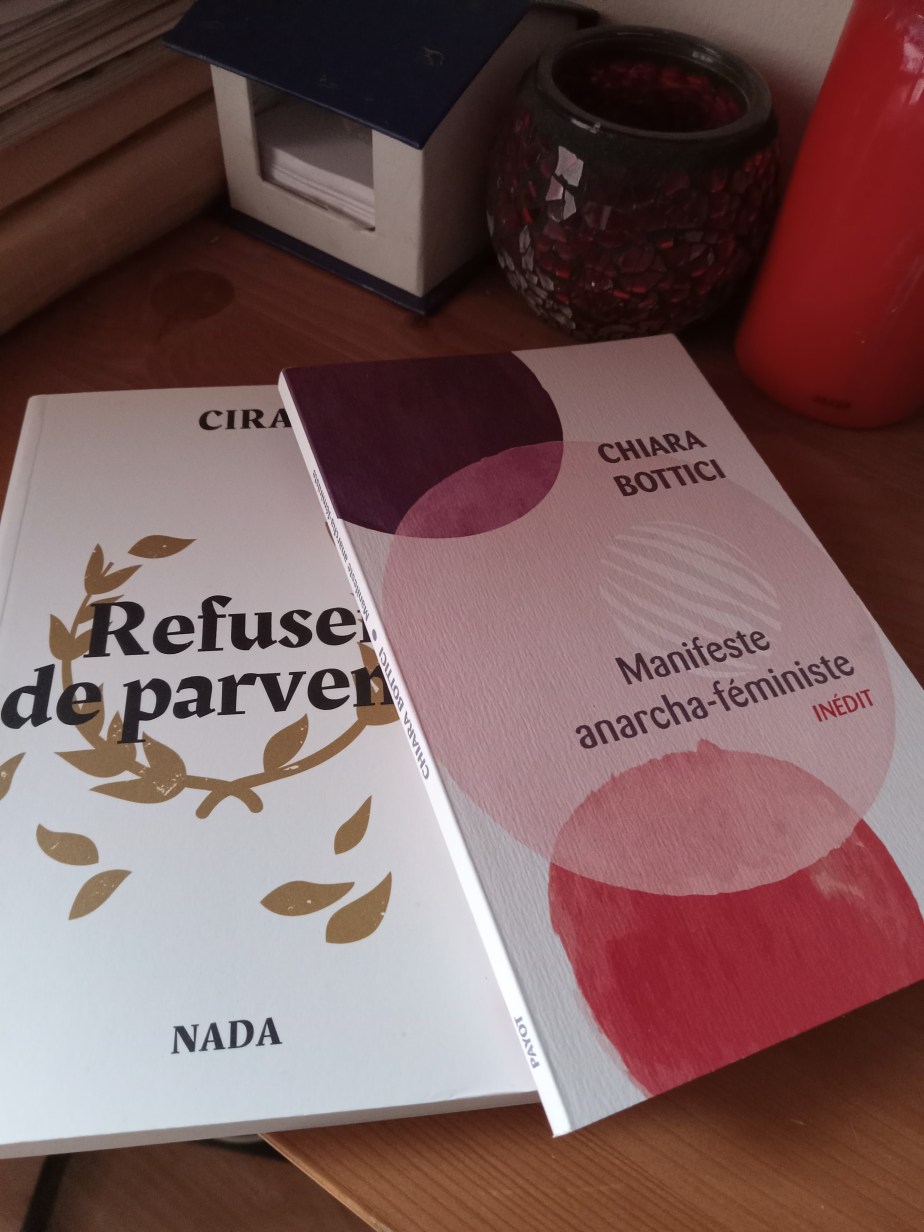
Books in 2025

If you read my blog, you’re probably familiar with my (attempt at a) tradition to post the most meaningful books I’ve read in the preceding year. I started this in 2021, when – not least connected to my work on epistemic positioning and the differential valuation of people who do not fit a particular ‘type’ of epistemic subject – I wrote about the year of reading only (or almost-only) books written by women and non-binary authors. I did the same in 2022. At the end of 2023, I was too burnt-out to write anything (my first – and so far only – Covid infection happened at that time, but it was only the crown of a pretty hellish year by most if not all standards); in 2024, I went back to the habit. I was in Belgrade, inspired by what was at the time a student occupation (of the building, and institution, that was my alma mater), and would grow into one of the biggest student-cum-civic movements in the region (I’ve written about it here and on multiple instances here, if you read Serbian/Croatian/Bosnian etc.). I wrote about books that gave me hope, a term I was never fond of and mostly did not use. And, of course, the events I witnessed in the subsequent year taught me to recognise and take it seriously.

I made up for one ‘missed’ year in February 2025, watching, from California the rapid (if not unforeseen) hostile takeover of the US, in particular the stepping up of immigration policing, and the (not-unrelated) crackdown on universities and, in particular, student protests. I wrote on books about resistance; not because I thought I had anything special to teach people on the ground, but because I was aware the Good Liberals of Social Media (likely most of my readership, though it’s possible I’m underestimating comrades) were comparatively under-prepared and inexperienced in dealing with *that* level of state collapse. There are both consequences and constraints to teaching people some of these skills at a practical level, so I thought the easiest and most useful thing to do, in the short term, is to share those written resources that were available internationally online.

Prior to that, however, I’ve made another decision. That decision had something to do with the process I’ve part-narrated here, but it also had something to do with the realisation that reading is a political act. Not in the self-aggrandizing, performative-intellectual mode that many still take for granted, but in the sense that the gift of attention is, truly, the most scarce resource. Thus refusing to dedicate it to either intellectual fads or resources considered de rigueur in a discipline (or, needless to say, the slop – AI-generated or not – on social media), and training it instead on something else is likely to produce unforeseeable consequences.

In other words, I only read books on anarchism.

Confession: I grew up anarchist, at least as far as early (very, shockingly early) drive towards autonomy and resistance to authority (which also led to multiple clashes with its institutions, something that should be a subject of a very different post) is concerned, but – until very recently – I rarely called myself one, not only because of believing (to paraphrase David Graeber) in the primacy of practice, but also because I have an innate dislike for fixed or stable “identities”, especially of the sort that trigger White Bros to either engage in (unsolicited, what else) “yes but” or approach with (pseudo-)questions like “but how would you solve the problem of [XYZ]?” (itself a reflection of the fact that they see every anarchist as Spokesperson for Anarchy, which betrays their assumption that every movement is in fact a PR operation). I read stuff on anarchism quite obsessively in my late teens and in my undergrad, haphazardly coming across random books, zines, and pamphlets then websites generated by Yugoslav/Serbian impressive plethora of publishers, organisations, distros, and samizdats, but it never made it into my ‘official’ academic portfolio (well, at least not as far as ‘formal’ references go). One part of it is the fact that anarchism is almost by definition opposed to academic conservatism, parochialism, and hierarchy; anarchists also tend to spur ‘scholarly’ publications and write instead for newspapers/magazines, zines, and blogs. Save for a few specialised corners of political thought, anarchist authors hardly ever make it into ‘the canon’. Of course, I quite inevitably read very much outside of the canon (and against it), but I was also socially aware enough to realise that trying to convince someone of the comparative value of Emma Goldman was not a particularly legit move in the academic establishment.

Also, I didn’t care. I never experienced the sort of academic (if only!) para-idolatric reverence some people feel for certain authors. Which is to say, I think there’s a lot of superb, really-relevant, useful writing that can be identified as anarchist (not all of which is signed by individual people, or at all, by the way), and I think there’s a lot of superb, really-relevant, useful writing that…isn’t. I read both; it has been my experience that, by and large, people are as inclined to ignore anarchist authors as non-anarchist authors, providing they are not white men. There are multiple ways to practice epistemic justice; in this process, the ‘how’ can be more important than the ‘who’.

Also, I forgot. By ‘forgot’ I mean that, having absorbed most of the writing available to me between 2000 and 2005, I moved on; carrying the little set of core values mostly unchallenged, not because I had the opportunity to act in accordance with my beliefs, but because I rarely had the opportunity to act in a way that made it clear how much they diverged from most of the orthodoxy. When I did, I systematically made choices that, sometimes incomprehensibly to myself, refused the hierarchy, authority, alliances, and rewards that, as someone pursuing a ‘career’ in the academia, I should have wanted. Of course, I also occasionally made – forced myself to make – other choices. This broke my heart; I swore never to make such choices again.

It’s easy to forget who you are. Academia makes it even easier, also, on occasions, providing you with extensive literature (and sometimes even academic posts, and promotions) that do that. This is what critics of ‘identity politics’ never get: it’s not (well, most of the time) individual people who play the politics. It’s institutions.

Deciding to willingly read only anarchist literature, then, was not only a way to reject the intellectual enclosure, sorting, and ordering that the academia never stops performing. It was also a way to train my own mind to be more open, courageous, and frank about what I think matters. To accept having to risk 1,000-word attempts to explain Marxist theory, or class politics, or the history of the Commune to me (it’s amazing how men never get tired of explaining things others already know about). Admittedly, it was also helped by the fact my current research engages explicitly with the anarchist intellectual tradition; that, too, was a choice.

More than anything, it was to dare to read not only outside of the academic but also of the anarchist canon; to refuse, consistently, to engage in the discussion about Did Kropotkin Really Mean That (you’d have to ask Kropotkin, and thanks in advance for informing me he is long passed, I totally did not know that); to focus on the practical, even if imperfect (nothing practical can ever be perfect) at the expense of the academically profound, even if writing is clumsy, to violate the academic canon of writing perfectly-formed, short sentences, with exactly the right balance of obtuseness and simplicity.

To disobey, terminally and forever, the enclosure that the academia seeks to perform on each and every one of us.

So, this year, I am daring you to do the same.

Refuse loyalty to the disciplinary, professional, intellectual, cognitive framework you have been raised in.

Refuse to perform ‘disloyalty’ by abundantly posting about your reading escapades, one Taschen catalog after another, one mainstream academic press publication after another, each with hefty royalties to the (star) author.

Refuse the fear of coming across as ‘simplistic’, or ‘uneducated’ (yes, academia makes you horribly under-educated, but not in the way you think), or ‘not sophisticated enough’; read for actual knowledge, read for pleasure, read for joy, read for hope, read for anger, read for vengeance, but most of all, stop reading only for yourself and whatever senescent gods of the intellectual realm you (still) serve and start reading for others, those who are alive, those who need it and cannot do it (either because they do not know the language or the jargon or are too misled by social media slop or are hungry or cannot read at all or are busy fighting fascists, feeding kids, getting arrested, burning out, trembling in face of the future, or have been systematically untaught to think and thus also to read) for themselves, or those who are yet to come, and who will be raised in a world of techbros’ dreams, where AI slop has successfully drowned out not only the capacity to think, but the memory of what that felt like.

Start now, and, as Crimethinc framed it, start everywhere.

(You will have probably surmised by now I am not going to give you specific books or reading suggestions. Feel free to start from your own gut – you can read short zines, pamphlets, how-to guides, or you can read classics like Silvia Federici’s Caliban and the Witch, Kropotkin’s Justice and Morality or The Conquest of Bread, or, of course, any mix thereof).

Here are some good places where you can access heaps of anarchist (and related) writing – and for free:

https://theanarchistlibrary.org/category/topic

https://libcom.org/

https://crimethinc.com/library

https://workingclasshistory.com/

https://www.marxists.org/ (yes, obviously, not all Marxists etc., but there are quite a few good resources here)

There are also several anarchist presses/distros (and it is always worth going to an anarchist bookfair if one is available in your part of the world, or going to the local infoshop/radical bookshop in your area).

On books and hope (2024)

This is the continuation of the habit I have kept for a few years, which is to write a post on books I have read that year. That said, “habit” is hardly a deserving name for something I did two years I a row – in 2021 and 2022 – and then dropped in 2023: the year had been too filled, both with ups and downs, and the context in which I read some of those books too convoluted; it is also possible I read more than I usually would (having been on research leave in spring) – or less. I wouldn’t know, as I gave up on keeping a list; I gave up on many other things, including possibly the last vestiges of ego-investment in the academia, which also meant I gave up on reading for competitive, pedagogical, or perfunctory reasons. In this context, coming up with a list of all the books I have read would have seemed a bit counterperformative; not least, the time I would have normally spent writing up this post – the quiet days after the end of term, as Xmas and New Year drag themselves over the hill – was spent flat out from Covid (which I finally caught, one and so far only time) and the ongoing pressure at work.

This year, I am coming back to this, but in order to share the books that brought me hope. This may seem like an odd choice for someone whose approach to knowledge always emphasised the ethical and political responsibility of recognising tendencies in the present that may lead to harmful and disastrous futures – even if that entailed coming to terms that, in not-insignificant ways, our present (in)action may be rendering certain kinds of futures impossible. This, for most of my life – starting with the rather famous moment when, aged eight, I argued to my father that Yugoslavia will fall apart – meant having the courage to be a ‘killjoy’, not only (or primarily) in terms of disrupting the cozy consensus that scaffolds some of the most odious things about contemporary social life – consumerism, patriarchy, xenophobia and racism – but also by pointing out, ceaselessly, that bleating starry-eyed about the revolution to come was, in very real ways, preventing us from bringing it about.

To toss the concept of ‘hope’ about might, from this perspective, seem at best a concession to sentimentality, in the same way in which I dutifully bellow ‘Merry Xmas’ back at people; at worst, like capitulation to the abscondence from the daily work of not reproducing the same systems that we (so eloquently) critique, which intellectuals of my sort are prone to, especially when we reach a certain career (st)age. I, at least, have always swatted away questions of hope or ‘exit’ (as one of my PhD examiners exasperatedly sighed towards the end of my viva: “Then there is no Aufhebung?”), in the same way in which I used to swat away questions of the sort of ‘What is to be done?’ before I decided to start doing less of knowledge production and more of…other stuff.

Why hope, then? Put simply, one of the rare justifications I find nowadays for continuing to do “academia” is that (nominally, at least) it entails two things: time to read (one might say, an obligation) and a platform to tell others so (as well as what not to read). And everyone needs a bit of hope. This is particularly important as I see growing numbers of (even educated) people fall for trash arguments along the lines of Stephen Pinker’s ‘Better Angels’ or other kinds of Pollyanna-ish optimism that usually serves to bolster capitalist, extractivist, or neocolonial approaches to ‘business as usual’. Thus, to be able to see ‘hope’ without, at the same time, ‘unseeing’ all things that render it impossible (the war in Gaza; continuous extraction; runaway climate crisis) becomes a difficult exercise in discernment and balancing – something that, in fact, academics of my sort are uniquely trained to do.

That said, not all of the books included in this list count as ‘academic’ – and most would not But they are what sustained me over the past year. I hope they can be of service to you.

Revenant ecologies: defying the violence of extinction and conservation (Audra Mitchell)

This is a book that challenges powerfully the thinking about extinction and conservation that dominates Anglo-academia. Particular points for taking a swipe at the ‘extinction industry’ of academic writing, and the books (many of which I admit I had enjoyed!) that write about extinction from a seemingly universalist perspective. On the other hand, Revenant Ecologies seems at times to take almost excessive care to avoid this. Regardless, it is a careful, engaging, and mobilising analysis that aims to avoid the po

As we have always done: indigenous freedom through radical resistance (Leanne Betasamosake Simpson)

I’ve admired Betasamosake Simpson’s writing for a long time (and also music! How cool it is to be a social theorist who also writes and performs music). This book is a reminder that undercurrents of resistance run deep, but also that freedom is a praxis – a constant one, at that.

Our history is the future: Standing Rock vs. the Dakota Access Pipeline, and the long tradition of Indigenous resistance (Nick Estes)

QED. Well, maybe there is a bit of a theme running through this year’s reading. But in a year that felt so long, and hopeless, and dark, I needed (printed) reminders that people have lived through (and survived) worse ordeals, and that they not only did not accept but actively challenged and fought against the colonial order and its successors, including extractivism.

Ecology of wisdom (Arne Naess)

Naess is one of those people who are larger than history gives them credit for – he is usually styled as the ‘founder of the deep ecology movement’, but Naess was a philosopher (prefiguring a lot of analytical thought), an ecologist, a spiritual thinker (a Buddhist and firmly committed to nonviolent action), and a mountaineer. ‘Ecology of wisdom’ is a compendium of his writings; thanks, in part, to masterful translation, the prose just flies off the page making it more like poetry (I’ll admit that the combination of analytic philosophy, Buddhism, and ecology is particularly likely to chime with how I feel and think about the world). Nonetheless, I find it hard to think anyone would not be charmed – at least anyone who still has a heart, and soul, in some part of the magical world we inhabit.

And if you need a reminder how to (re)discover it, these two are highly recommended: Reclaiming the wild soul (Mary Reynolds Thompson) and  Enchanted life: reclaiming the magic and the wisdom of the natural world  (Sharon Blackie). I *really* like Sharon Blackie’s writing – it manages to be equal parts environmentalist, witchy, psychoanalytic and folksy without becoming too bound by conventions of any.

Foxfire, wolfskin: and other stories of shapeshifting women (Sharon Blackie) is a wonderful retelling of some of the classical European folk tales, with a gender twist that does not come across as pedagogical. I absolutely adored it – and even got it for a few friends.

A natural history of the future (Rob Dunn)

This is a great (admittedly, popular science) book on the impacts of the ongoing climate change and other human-induced changes on the biosphere. It brings in new arguments and perspectives, even if you’re a seasoned reader of the genre, and I’d say it’s informed by deep ecology whilst retaining a pleasantly matter-of-factly tone.

Claros del Bosque (Maria Zambrano)

I used the two unforeseen trips to Serbia in springtime to delve into the rich body of non-English philosophical and theoretical works in translation, something I dearly miss in bewilderingly anglo-centric UK (even major works in French or German are increasingly translated with a delay, if at all). I chanced upon the Serbian translation of Zambrano’s Claros del Bosque (forest clearings? ) in one of my favourite (independent) bookshops, but given that 2024 was also the year in which I decided to refresh my Spanish, I also got the original (the combination proving the right level for my Spanish reading skill). Zambrano (a metaphysician, essayist, and Spanish republican) was yet another ‘forgotten’ philosopher whose work I enjoyed discovering in the past two years, alongside Anne Dufourmantelle and Mari Ruti; her writing also reminded me of Clarice Lispector, with the combination of the poetic and the philosophical.

Drive your plow over the bones of the dead (Olga Tokarczuk)

I returned to reading Drive your plow…late this year, after a chance encounter on the plane this spring reminded me it was one of the (many) books I had been meaning to come back to. Let’s just say I do not regret the decision: it also linked to the research project I will be working on over the next year and a half – which just goes on to show things tend to come back at exactly the right time.

The Dawn of Everything: A new history of humanity (David Graeber & David Wengrow)

One of the wonderful things about my new research project was returning to the things that excited me about anthropology as an undergrad, including its ability to challenge large-scale (often Eurocentric) generalisations. In this vein, I’ve started reading Graeber and Wengrow’s The Dawn of Everything, which I’m currently enjoying very much; the only downside being that I am beginning to fear they may have already written the book I had been planning to write as the outcome of this research project – but yet, it’s a good problem to have, and I am sure I will still have something to contribute.  

Fields, factories, and workshops (Peter Kropotkin)

Another wonderful corollary of this research project is that it allows me to revisit multiple traditions of writing that were foundational to my thinking as an undergrad – not only anthropology, but also (classical) anarchist political theory. In this context, I am (re)reading Kropotkin’s Mutual Aid; given how much anarchist political theory has been discounted and undervalued, not only in mainstream political theory, but also among more progressive forms of reading, this will hopefully play a small part in restoring interest in it.

We do ‘till we free us: abolitionist organizing and transforming justice (Mariame Kaba)

Kaba’s writing is by now semi-legendary, but it also makes sense to remember that it is very down-to-earth, and that it arose from the lived experience of day-to-day abolitionist organising. In the UK context, in which the absence of sustained resistance to forms of exploitation old and new can be dispiriting at best, it is a reminder that forms and practice of resistance do exist elsewhere, and that it’s possible to learn from them.

Climate strike (Derek Wall)

Wall’s book is a really good primer on the relevance of labour organizing, and industrial action, in the face of climate crisis. It is also a potent reminder that problems of climate change and extractivism cannot be addressed separately from questions of labour, which is a much-needed aid in the political context where connecting the two can sometimes feel like an uphill battle.

We are ‘Nature’ defending itself: entagling art, activism, and autonomous zones (Isabelle Fremeaux and Jay Jordan)

This is the story of the French temporary autonomous zone (ZAD) developed at Notre-Dame-des-Landes to stop a proposed airport. More than that, it’s a story about resistance and resilience. It’s a story that tells us that the machine can be stopped.

Constellations of care: anarcha-feminism in practice (Cindy Barukh Milstein)

This is a great compendium of examples, texts, and experiences from different fronts of feminist, queer, and other kinds of intersectional anarchist organising. From infoshops and free libraries to community health initiatives to bike riders, these stories remind us that the world is full of examples of communities existing otherwise, sometimes for longer, sometimes for shorter periods of time, but often all it takes is a few people, a few good ideas, and a commitment to not give up ahead of even trying, to make a lasting contribution to a different world.

Radical Intimacy (Sophie K. Rosa)

I have a long-standing interest in alternative models of relationality (‘alternative’ meaning all that do not privilege heteropatriarchal, monogamous couple-based, reproduction-oriented family) so most of the arguments Rosa writes about are familiar – from Kim TallBear’s writing about non-settler-colonial-normative Indigenous modes of relating, to Sophie Lewis’s take on family abolition – but it is refreshing to see them presented in a succinct, carefully analysed, and user-friendly format. Especially for people who are new to this angle of critique, it’s a really welcome introduction; for others, it’s a handy compendium/reminder of the plethora of the ways in which humans have been relating otherwise – and a powerful primer for ongoing and future attempts to do so.

One of the last books I came to in 2024 (am, in fact, still reading) is also one of the best – Vanessa Machado de Oliveira’s Hospicing Modernity. Earlier this year, prompted, in part, by the war in Gaza and, in part, by the need to explain some of the choices I made in the course of it – including the decision to redirect more of my energy into the activities, goals and values I support – I wrote two posts [1] [2]; let’s just say that reading Machado de Oliveira’s book earlier would have saved me the labour, as she wrote it much better than I ever could.

The penultimate item on the list is not a book, but a magazine – Resurgence & the Ecologist, which I eventually got a subscription for, despite trying to talk myself out of it (youdontneedfeelgoodmagazinesubscriptionsthisisjustmorepapertheworldisonfire) – after all, it is much better than buying The Economist, even if very occasionally.

The final publication of this year, however, is a pamphlet I encountered while visiting one of the student occupations in Belgrade – it was a delight to see it both because I always enjoy CrimethInc materials (returning to reading more anarchism is probably one of the most healing things I have experienced this year) and because I think they are enormously useful for succinctly reminding people why things feel very, very wrong…and what we can do about it.

Happy New Year!