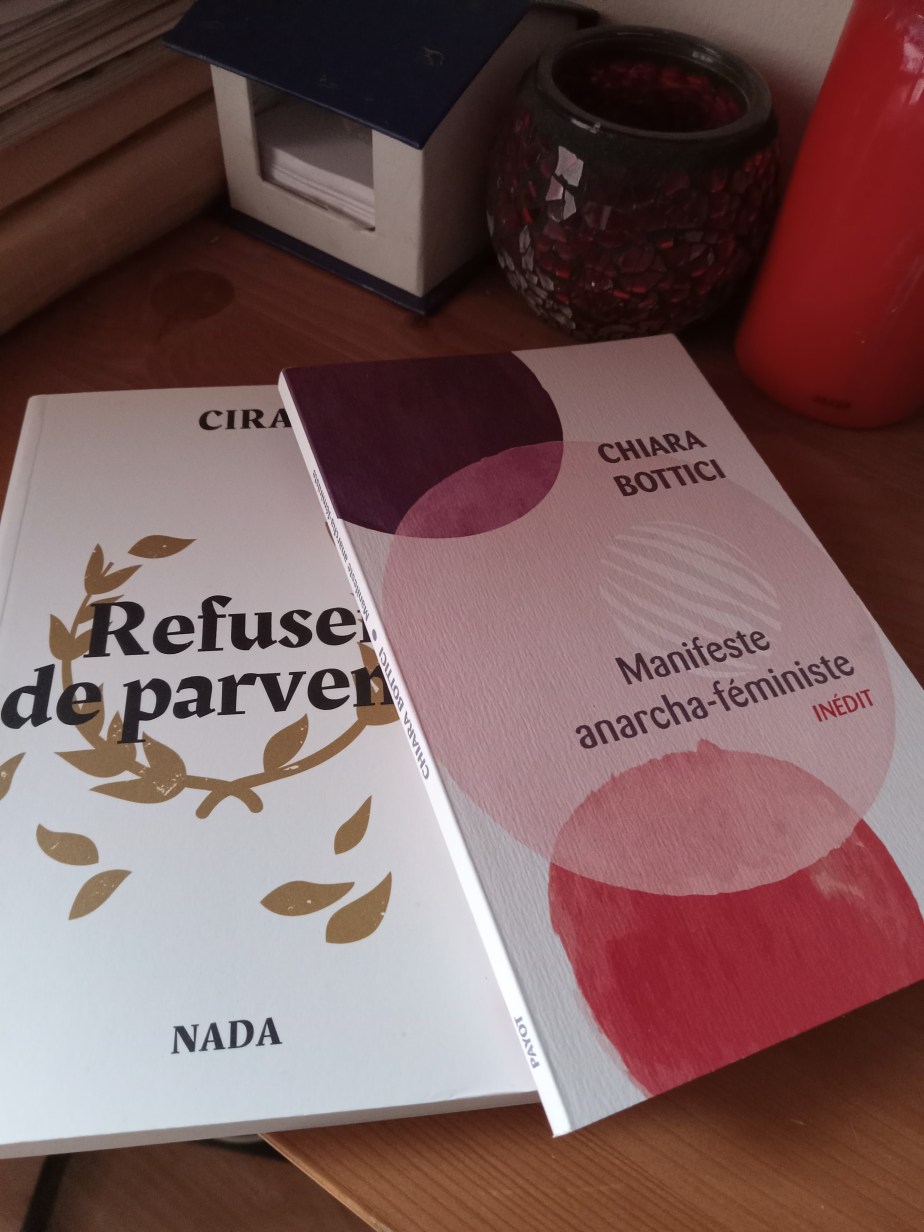
If you read my blog, you’re probably familiar with my (attempt at a) tradition to post the most meaningful books I’ve read in the preceding year. I started this in 2021, when – not least connected to my work on epistemic positioning and the differential valuation of people who do not fit a particular ‘type’ of epistemic subject – I wrote about the year of reading only (or almost-only) books written by women and non-binary authors. I did the same in 2022. At the end of 2023, I was too burnt-out to write anything (my first – and so far only – Covid infection happened at that time, but it was only the crown of a pretty hellish year by most if not all standards); in 2024, I went back to the habit. I was in Belgrade, inspired by what was at the time a student occupation (of the building, and institution, that was my alma mater), and would grow into one of the biggest student-cum-civic movements in the region (I’ve written about it here and on multiple instances here, if you read Serbian/Croatian/Bosnian etc.). I wrote about books that gave me hope, a term I was never fond of and mostly did not use. And, of course, the events I witnessed in the subsequent year taught me to recognise and take it seriously.
I made up for one ‘missed’ year in February 2025, watching, from California the rapid (if not unforeseen) hostile takeover of the US, in particular the stepping up of immigration policing, and the (not-unrelated) crackdown on universities and, in particular, student protests. I wrote on books about resistance; not because I thought I had anything special to teach people on the ground, but because I was aware the Good Liberals of Social Media (likely most of my readership, though it’s possible I’m underestimating comrades) were comparatively under-prepared and inexperienced in dealing with *that* level of state collapse. There are both consequences and constraints to teaching people some of these skills at a practical level, so I thought the easiest and most useful thing to do, in the short term, is to share those written resources that were available internationally online.
Prior to that, however, I’ve made another decision. That decision had something to do with the process I’ve part-narrated here, but it also had something to do with the realisation that reading is a political act. Not in the self-aggrandizing, performative-intellectual mode that many still take for granted, but in the sense that the gift of attention is, truly, the most scarce resource. Thus refusing to dedicate it to either intellectual fads or resources considered de rigueur in a discipline (or, needless to say, the slop – AI-generated or not – on social media), and training it instead on something else is likely to produce unforeseeable consequences.
In other words, I only read books on anarchism.
Confession: I grew up anarchist, at least as far as early (very, shockingly early) drive towards autonomy and resistance to authority (which also led to multiple clashes with its institutions, something that should be a subject of a very different post) is concerned, but – until very recently – I rarely called myself one, not only because of believing (to paraphrase David Graeber) in the primacy of practice, but also because I have an innate dislike for fixed or stable “identities”, especially of the sort that trigger White Bros to either engage in (unsolicited, what else) “yes but” or approach with (pseudo-)questions like “but how would you solve the problem of [XYZ]?” (itself a reflection of the fact that they see every anarchist as Spokesperson for Anarchy, which betrays their assumption that every movement is in fact a PR operation). I read stuff on anarchism quite obsessively in my late teens and in my undergrad, haphazardly coming across random books, zines, and pamphlets then websites generated by Yugoslav/Serbian impressive plethora of publishers, organisations, distros, and samizdats, but it never made it into my ‘official’ academic portfolio (well, at least not as far as ‘formal’ references go). One part of it is the fact that anarchism is almost by definition opposed to academic conservatism, parochialism, and hierarchy; anarchists also tend to spur ‘scholarly’ publications and write instead for newspapers/magazines, zines, and blogs. Save for a few specialised corners of political thought, anarchist authors hardly ever make it into ‘the canon’. Of course, I quite inevitably read very much outside of the canon (and against it), but I was also socially aware enough to realise that trying to convince someone of the comparative value of Emma Goldman was not a particularly legit move in the academic establishment.
Also, I didn’t care. I never experienced the sort of academic (if only!) para-idolatric reverence some people feel for certain authors. Which is to say, I think there’s a lot of superb, really-relevant, useful writing that can be identified as anarchist (not all of which is signed by individual people, or at all, by the way), and I think there’s a lot of superb, really-relevant, useful writing that…isn’t. I read both; it has been my experience that, by and large, people are as inclined to ignore anarchist authors as non-anarchist authors, providing they are not white men. There are multiple ways to practice epistemic justice; in this process, the ‘how’ can be more important than the ‘who’.
Also, I forgot. By ‘forgot’ I mean that, having absorbed most of the writing available to me between 2000 and 2005, I moved on; carrying the little set of core values mostly unchallenged, not because I had the opportunity to act in accordance with my beliefs, but because I rarely had the opportunity to act in a way that made it clear how much they diverged from most of the orthodoxy. When I did, I systematically made choices that, sometimes incomprehensibly to myself, refused the hierarchy, authority, alliances, and rewards that, as someone pursuing a ‘career’ in the academia, I should have wanted. Of course, I also occasionally made – forced myself to make – other choices. This broke my heart; I swore never to make such choices again.
It’s easy to forget who you are. Academia makes it even easier, also, on occasions, providing you with extensive literature (and sometimes even academic posts, and promotions) that do that. This is what critics of ‘identity politics’ never get: it’s not (well, most of the time) individual people who play the politics. It’s institutions.
Deciding to willingly read only anarchist literature, then, was not only a way to reject the intellectual enclosure, sorting, and ordering that the academia never stops performing. It was also a way to train my own mind to be more open, courageous, and frank about what I think matters. To accept having to risk 1,000-word attempts to explain Marxist theory, or class politics, or the history of the Commune to me (it’s amazing how men never get tired of explaining things others already know about). Admittedly, it was also helped by the fact my current research engages explicitly with the anarchist intellectual tradition; that, too, was a choice.
More than anything, it was to dare to read not only outside of the academic but also of the anarchist canon; to refuse, consistently, to engage in the discussion about Did Kropotkin Really Mean That (you’d have to ask Kropotkin, and thanks in advance for informing me he is long passed, I totally did not know that); to focus on the practical, even if imperfect (nothing practical can ever be perfect) at the expense of the academically profound, even if writing is clumsy, to violate the academic canon of writing perfectly-formed, short sentences, with exactly the right balance of obtuseness and simplicity.
To disobey, terminally and forever, the enclosure that the academia seeks to perform on each and every one of us.
So, this year, I am daring you to do the same.
Refuse loyalty to the disciplinary, professional, intellectual, cognitive framework you have been raised in.
Refuse to perform ‘disloyalty’ by abundantly posting about your reading escapades, one Taschen catalog after another, one mainstream academic press publication after another, each with hefty royalties to the (star) author.
Refuse the fear of coming across as ‘simplistic’, or ‘uneducated’ (yes, academia makes you horribly under-educated, but not in the way you think), or ‘not sophisticated enough’; read for actual knowledge, read for pleasure, read for joy, read for hope, read for anger, read for vengeance, but most of all, stop reading only for yourself and whatever senescent gods of the intellectual realm you (still) serve and start reading for others, those who are alive, those who need it and cannot do it (either because they do not know the language or the jargon or are too misled by social media slop or are hungry or cannot read at all or are busy fighting fascists, feeding kids, getting arrested, burning out, trembling in face of the future, or have been systematically untaught to think and thus also to read) for themselves, or those who are yet to come, and who will be raised in a world of techbros’ dreams, where AI slop has successfully drowned out not only the capacity to think, but the memory of what that felt like.
Start now, and, as Crimethinc framed it, start everywhere.
(You will have probably surmised by now I am not going to give you specific books or reading suggestions. Feel free to start from your own gut – you can read short zines, pamphlets, how-to guides, or you can read classics like Silvia Federici’s Caliban and the Witch, Kropotkin’s Justice and Morality or The Conquest of Bread, or, of course, any mix thereof).
Here are some good places where you can access heaps of anarchist (and related) writing – and for free:
https://theanarchistlibrary.org/category/topic
https://crimethinc.com/library
https://workingclasshistory.com/
https://www.marxists.org/ (yes, obviously, not all Marxists etc., but there are quite a few good resources here)
There are also several anarchist presses/distros (and it is always worth going to an anarchist bookfair if one is available in your part of the world, or going to the local infoshop/radical bookshop in your area).
Discover more from Jana Bacevic
Subscribe to get the latest posts sent to your email.
 Jana Bacevic