
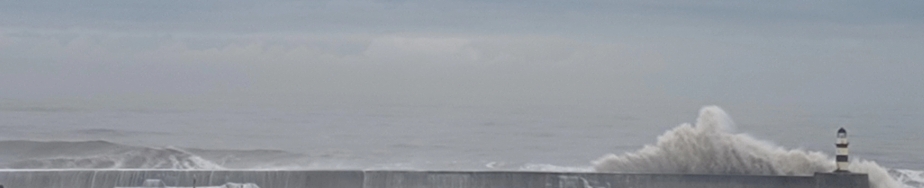
The weather, as writers on climate change from Amitav Ghosh to Jenny Offill (and many others) have been noting, hardly ever figures at the centre of the plot. Even stories that have a large climactic disaster determining the world they build (The Road, or Margaret Atwood’s Maddadam series, or Octavia Butler’s Parables), the event is usually, in a somewhat punny phrase, precipitating; it happens before, or because, it does not change, it does not change with us, and it cannot be changed.
It is weird to think that a concept so clearly defined by the tendency to change – namely, climate change – is at the same time an acknowledgment of the absolutely planetary scope of human agency (after all, it is human-induced climate change that should most concern us) and of its limits (after all, it is clear that we are locked into at least 1.5C degree warming now, with all the unpredictability that brings). To think about the weather, then, is to dwell on – and at – the very boundary of the human condition: both what we can achieve – destroy, mostly – and what we cannot (repair, mostly). It is also, as Brian Wynne brilliantly analyzed, to revisit the boundaries between observation (or phenomenology), measurement (or attempt at quantification/standardization), and indeterminacy, and thus pose the question that forms the crux of one of the strands of my work: what is the relationship between knowing about and doing something about the future? Or, to put it slightly differently, is the future something we know about or something we do?
To dream of the weather, then, adds another degree of radical indeterminacy: to the extent to which dreams are not volitional (and even for fans of lucid dreaming, that is still a large extent), the incursion of weather into dreams further refracts the horizon of agency. While in dreams we think we can choose what we do (or don’t do), but we are both in charge and not in charge; we are (again, with exceptions) not aware of the dream as we are producing it, but we are producing it; there is no-one else there, right?
It struck me some time ago that, to the best of my knowledge, not many people dream about the weather. Or, in the vein of the backdrop that Ghosh writes about, even if they do, they dream of the weather as something that just happens. True to form, I had a dream that featured a blizzard that very night; but it also featured a snow plough, or road sweeper/gritter, I am not sure which.
Last night, however, I had a dream of a storm cloud passing all over North America, and then getting to the UK. In my dream, the southwest tip of the UK – Cornwall, a bit of Dorset, Somerset – was the only part that was spared. This was strange, as I was sure that what precipitated the dream was reading the forecast about storm Nelson, which predicted high impact in the southwest, but almost none in the northeast, where I live. Yet, when I woke up, rain was lashing against my windows; a thick, low cloud hung over most of the coast.
Strange weather?
Discover more from Jana Bacevic
Subscribe to get the latest posts sent to your email.
 Jana Bacevic
thanks for the links, are we really in charge or is it more that we are just part of the (long and wide accumulations) problem? After the major shocks (to date anyway) of covid one can see how nations like the US would like to protect themselves against events like supply-chain disruptions by bringing things back into realms where they have more control but even these efforts generally come up short and they don’t compare to phenomena like weather which have no respect for borders or the like (not to even get into fever-dreams like “waves” of migrants and or climate refugees). Here in the midwest of the US those of us who shrink heads do run into a lot of post storm nightmares (and other climate related ptsd-ish symptoms) but I think many of the dreams that people remember are of anxieties induced by being in settings/systems in which the dreamer has little to no control, is expected to meet external demands that they fear exceed their abilities to perform, from work to school and such. Seems to me that knowing-about the future is one of the ways we make the future, no?
why, yes, I do believe we are in charge, notwithstanding individual and collective differences in power – concentrated action is very much possible (look at the example of CFCs and the ozone layer). good point on the midwest – I was thinking a bit about the ‘dust bowl’ depiction at the start of Interstellar (which happens to be IMO the best part of the film). and thanks for the interview with Pickering – I used to read more of his work, this is a good reminder!
Andy is a bit new-age in the way that particle physicists of his generation/bent sometimes are but I appreciate both his emphasis on performativity and on how little information/control we really have as we are situated in complex environs that exceed our grasps. “We” can obviously make some differences that make a difference but look at the all too real limits on the power of the president of the US to get his “green new deal” thru the Congress (let alone the Supreme Court and its invented but all too real super veto power The Major Questions “doctrine”) and even if our president could get everything he wanted we are all really dependent on what China does and even their supreme authority is running into issues of power and control in no small part because there are so many different players/interests within his own state let alone all those he needs to harness for his external extractive efforts. What we used to call “wicked” problems are now diagnosed as poly-crises but I think the issues are the same, imagine you’ve come across these folks but if not:https://www.phenomenalworld(dot)org/series/the-polycrisis/
I haven’t seen interstellar but I’ll try and find that scene thanks. do you know Claire’s work:
Bloch offers Dreams for a Better Life
https://kpfa.org/episode/against-the-grain-april-16-2024/